Agriculture
14 Factors That Affect Agricultural Land Value in India 2026
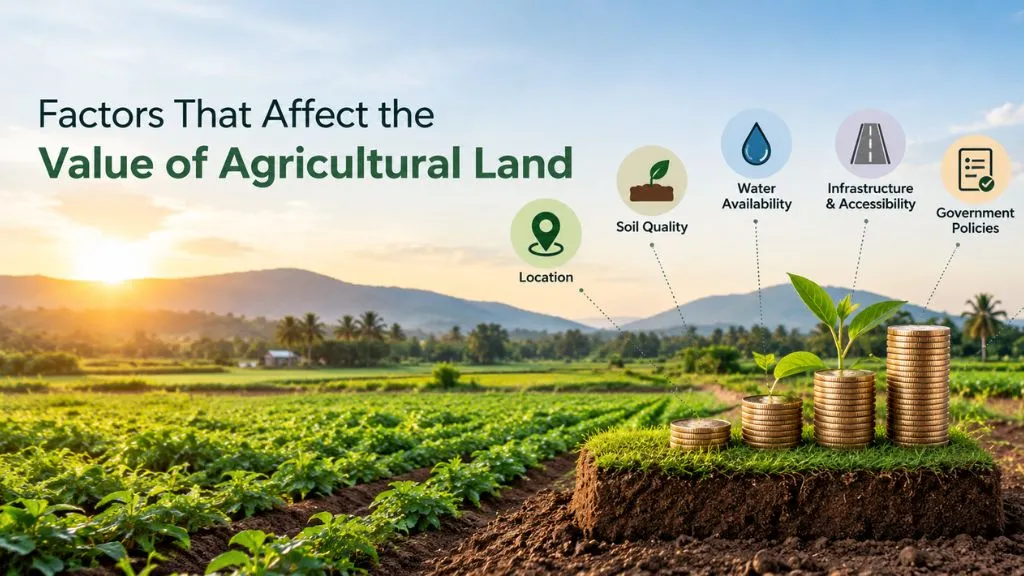
Buying agricultural land is not only about the best plot with the best ratio of size to cost. Two farms, which are several kilometers apart, can be completely different in soil bearing capacity, water access, location, trafficability, infrastructure, and prospects.
Consequently, for a farmer who wants to make an investment in the form of purchasing a plot of land, a comparative analysis of the factors affecting agricultural land prices is extremely relevant. Although the land may seem like a great bargain, it must have many benefits in the future for the owner to be worthwhile.
In this guide, we'll explore 14 key factors that affect agricultural land value and explain what buyers should evaluate before investing in farmland.
Soil Quality and Fertility
Assessment of the quality of the soil is among the primary criteria in purchasing land. Land with fertile soil, sufficient organic content, pH, and other qualities enables high yields of agricultural products. Thus, land requiring specific labor and expenses for cultivation improvements may turn out to be advantageous to the owner, as he will save on the costs related to land preparation.
Another crucial criterion is the structure of the soil, which should be suitable for growing crops. On the one hand, the soil should not be too loose, as it may retain water excessively. On the other hand, it should not be compact, as it will not be able to hold water for plants’ absorption. Both of these qualities are disastrous for farming and should be taken into account during land purchase.
Finally, the buyer should request a land survey to identify the most profitable use of the land. In this case, a soil test will help determine the amount of nutrients, organic matter, acidity, and other features.
Verify Water Availability and Irrigation Access
Water is essential to agricultural production, making it one of the determinants of farmland value factors.
Therefore, land with a consistently reliable water source may be more valuable than land with a questionable or costly irrigation system. The source of water can come from wells, boreholes, canals, rivers, reservoirs, or any other nearby bodies of water. Additionally, if the seller has already invested in the land, such improvements as drip irrigation, sprinklers, pipelines, water storage tanks, and other infrastructure can be valuable assets.
Nevertheless, not all of these improvements can be considered valuable. One should also assess the reliability of the source, its quality, availability, and limitations.
Location and Road Accessibility
Location is an essential component in almost all types of real estate, and agricultural land is not an exception.
Agricultural land that is close to roads, markets, agricultural infrastructure, and transportation hubs is more valuable and simpler to develop.
Especially when it comes to farmland, being close to the roadways is often a significant factor.
The reason for this is that to transport the harvest or even the equipment to and from the farmland, one will have to use the road infrastructure.
In addition, farmland that is close to rapidly developing towns and cities may be beneficial due to potential future value and alternate uses, provided that there are no restrictions and regulations.
Therefore, the location is often one of the most important factors determining the price of agricultural land.
Understand Local Climate and Seasonal Risks
Agriculture is closely related to the properties of the local climate.
The temperatures, amount of rainfall, air humidity, growing season and the frequency of extreme weather events are all essential factors that determine what agricultural products will be.
A region with a relatively stable climate will have a more predictable yield of specific goods.
On the other hand, frequent droughts, floods, storms or temperature swings in one region will make it harder for a grower to make a profit and will increase the risk factor due to potential losses.
Therefore, when buying land for farming, it is essential to consider not only the current state of the plot but also the climate trends that may affect the business in the future.
Estimate Farming Income and Operating Costs
Land suitable for growing any particular crop: it is not always possible to use it for growing different crops since the land’s properties, climate, water availability, topography, and agricultural traditions determine what can be grown there.
Fertile land capable of producing commercial crops or those with high yield is more valuable than land limited in its agricultural use.
For this reason, it is important to remember that land value is not determined solely by the price of the land, but also by its potential income, expenditures, productivity, and risks.
Market Demand and Commodity Prices
Agricultural land is not a separate entity from the agricultural market.
The demand for specific crops and commodity prices may influence farms’ potential profits, thus shaping the demand for land. For example, if farmers can get good money out of specific crops, the demand for arable land suitable for their growth will increase. At the same time, a decrease in commodity prices or demand for agricultural goods can reduce costs, farmers’ incomes, and, consequently, land demand.
In addition, the state of the wider economy can also affect supplies and demand. For example, inflation, federal interest rates, availability of credit, and investors’ interest in farmland can influence buyers’ demand.
Existing Infrastructure and Improvements
A farm with infrastructure that has excellent characteristics may be more attractive than the same one but without such qualities.
Among these assets are:
irrigation
storage
fencing
buildings
greenhouses
internal roads
electricity
water storage
equipment sheds
These objects are significant for the further development of the site; therefore, their presence or absence should be considered when calculating the value. On the other hand, the state of the existing structures should also be taken into account since the new owner will have to spend money on their renovation, removal or even replacement if they are dilapidated.
Land Size, Shape and Topography
The land’s size is important, but its location is also significant
Large parcels of land may be easier to manage than many smaller plots, and the shapes can affect the ease of use
The land’s topography is also a factor in the price. Land that tumbles of hills and valleys is generally more challenging to cultivate than an evenly leveled parcel,
Drainage and potential for waterlogging are essential elements to consider while buying land.
Road Access and Nearby Infrastructure
A property may have excellent soil and water, but poor accessibility can still affect its value.
A well-connected farm can make it easier to transport harvested produce to markets and bring supplies to the property. Proximity to highways, local roads, warehouses, processing centres and other agricultural infrastructure can therefore influence operating costs.
This is particularly relevant when comparing two properties with similar soil and production potential.
Zoning, Land-Use Rules and Regulations
The one area where you should not be tempted to assume is the law.
Make sure you check on the legal use of the land before going in to invest.
Land-use laws, zoning restrictions, building codes, agricultural restrictions, water laws, tax laws, and environmental regulations are just some of the variables that should be considered when dealing with the value of land.
Even though the parcel of land may be a short drive from an expanding metro area, it does not mean that it can be instantly changed from agricultural land to residential or commercial land.
Always research and verify local restrictions and regulations before investing.
Proximity to Urban Areas and Future Development
Land situated near big cities or planned infrastructure projects may be of interest for different reasons.
The increasing population, new infrastructure, industrialization, housing construction and other projects may increase the value of the land. Nevertheless, one should not speculate over the development and study actual plans, rules and details of the projected improvements of the land.
Current Rental or Farming Income
For an investor, the returns on the agricultural land might come from the income it produces.
A plot currently producing some sort of income from agriculture or other sources is significantly different from one that is not used yet and brings no profit.
By calculating the numbers on the income and expenditures, the investor will be able to make the right choice, instead of thinking only of the potential benefits in the future and the risks associated with them.
This is an important step to determine the income that the farmland can potentially bring.
Interest Rates and Investment Conditions
The rate of interest is a factor which may influence the demand for agricultural land.
One of the reasons why farmers buy land is to finance their purchase on credit.
However, increases in interest rates make borrowing more expensive and thus reduce the appetite of investors.
Therefore, a farmer who wishes to buy farmland on credit will be deterred when the rate of interest is high.
This means that apart from the attributes of the land being sold, factors such as the state of the economy and the financial system can influence demand for farmland.
Environmental Risks and Land Management
Long-term land health can often dictate the kind and amount of profit that will be derived from the land.
Losses due to erosion, drainage issues, infertility, pollution or poor land management can considerably impact the ability of any parcel to make profits.
At the same time, the proper maintenance of the land, including soil conservation, water management, prevention of erosion, and other techniques will allow it to sustain the land’s productivity for the long run.
Therefore, for the land that is bought for long-term profit, the maintenance of its qualities is paramount and should not be ignored for the sake of short-term gains.
How to Evaluate Agricultural Land Before Investing?
Before deciding whether a particular property is worth the asking price, buyers should look at the complete picture rather than focusing on just one factor.
A basic evaluation can include:
Test the soil: Check fertility, pH, nutrients, organic matter, and drainage.
Verify water availability: Understand the source, reliability, quality, and associated costs.
Assess accessibility: Check road conditions and distance to markets and essential services.
Study the area's climate: Look at rainfall patterns and potential weather risks.
Calculate potential income: Estimate realistic agricultural income and operating expenses.
Inspect existing infrastructure: Account for both useful improvements and potential repair costs.
Check legal documents and land-use rules: Verify ownership, permitted uses, restrictions, and applicable regulations.
Compare nearby properties: Look at recent transactions and comparable land rather than relying solely on the seller's asking price.
Consider future potential carefully: Examine verified infrastructure and development plans without assuming that every proposed project will happen.
Calculate the overall investment potential: Compare the purchase price with expected income, expenses, risks, and long-term prospects.
Final Thoughts
Agricultural land value is influenced by a combination of physical, economic, environmental, and legal factors. Soil fertility, water availability, location, accessibility, crop productivity, existing infrastructure, and land-use regulations all contribute to a property's suitability and market value.
However, a higher asking price does not automatically mean better investment potential, just as cheaper land is not necessarily a bargain. Buyers should compare similar properties, verify ownership and land-use documents, assess water and soil conditions, and calculate the likely costs of cultivation, maintenance, and infrastructure improvements.
It is also important to distinguish between the land's current agricultural value and its potential for future appreciation. Nearby urban development or proposed infrastructure may influence demand, but any expected increase in value should be assessed carefully rather than assumed.
Ultimately, a sound farmland purchase decision comes from evaluating the purchase price, productive potential, ongoing expenses, legal status, and associated risks together. This approach helps buyers make a more informed comparison and determine whether a particular parcel of agricultural land suits their farming objectives or long-term investment plans.
FAQs
1. What factors affect agricultural land value?
Location, road access, water availability, soil quality, land size, legal status, and nearby development can all affect agricultural land value.
2. What are the main farmland value factors to consider?
The key farmland value factors include soil fertility, irrigation, accessibility, location, land use potential, and demand in the surrounding area.
3. Do infrastructure and location affect agricultural land prices?
Yes. Good road connectivity, nearby towns, transport links, and planned infrastructure can influence agricultural land prices.
4. How can I understand farmland returns before investing?
Look at the land’s purchase price, agricultural income potential, appreciation prospects, maintenance costs, and other ongoing expenses before estimating farmland returns.
5. Is agricultural land investment a good long-term option?
Agricultural land investment can offer long-term ownership and potential appreciation, but returns depend on location, land quality, market conditions, and how the land is used.
Buying agricultural land is not only about the best plot with the best ratio of size to cost. Two farms, which are several kilometers apart, can be completely different in soil bearing capacity, water access, location, trafficability, infrastructure, and prospects.
Consequently, for a farmer who wants to make an investment in the form of purchasing a plot of land, a comparative analysis of the factors affecting agricultural land prices is extremely relevant. Although the land may seem like a great bargain, it must have many benefits in the future for the owner to be worthwhile.
In this guide, we'll explore 14 key factors that affect agricultural land value and explain what buyers should evaluate before investing in farmland.
Soil Quality and Fertility
Assessment of the quality of the soil is among the primary criteria in purchasing land. Land with fertile soil, sufficient organic content, pH, and other qualities enables high yields of agricultural products. Thus, land requiring specific labor and expenses for cultivation improvements may turn out to be advantageous to the owner, as he will save on the costs related to land preparation.
Another crucial criterion is the structure of the soil, which should be suitable for growing crops. On the one hand, the soil should not be too loose, as it may retain water excessively. On the other hand, it should not be compact, as it will not be able to hold water for plants’ absorption. Both of these qualities are disastrous for farming and should be taken into account during land purchase.
Finally, the buyer should request a land survey to identify the most profitable use of the land. In this case, a soil test will help determine the amount of nutrients, organic matter, acidity, and other features.
Verify Water Availability and Irrigation Access
Water is essential to agricultural production, making it one of the determinants of farmland value factors.
Therefore, land with a consistently reliable water source may be more valuable than land with a questionable or costly irrigation system. The source of water can come from wells, boreholes, canals, rivers, reservoirs, or any other nearby bodies of water. Additionally, if the seller has already invested in the land, such improvements as drip irrigation, sprinklers, pipelines, water storage tanks, and other infrastructure can be valuable assets.
Nevertheless, not all of these improvements can be considered valuable. One should also assess the reliability of the source, its quality, availability, and limitations.
Location and Road Accessibility
Location is an essential component in almost all types of real estate, and agricultural land is not an exception.
Agricultural land that is close to roads, markets, agricultural infrastructure, and transportation hubs is more valuable and simpler to develop.
Especially when it comes to farmland, being close to the roadways is often a significant factor.
The reason for this is that to transport the harvest or even the equipment to and from the farmland, one will have to use the road infrastructure.
In addition, farmland that is close to rapidly developing towns and cities may be beneficial due to potential future value and alternate uses, provided that there are no restrictions and regulations.
Therefore, the location is often one of the most important factors determining the price of agricultural land.
Understand Local Climate and Seasonal Risks
Agriculture is closely related to the properties of the local climate.
The temperatures, amount of rainfall, air humidity, growing season and the frequency of extreme weather events are all essential factors that determine what agricultural products will be.
A region with a relatively stable climate will have a more predictable yield of specific goods.
On the other hand, frequent droughts, floods, storms or temperature swings in one region will make it harder for a grower to make a profit and will increase the risk factor due to potential losses.
Therefore, when buying land for farming, it is essential to consider not only the current state of the plot but also the climate trends that may affect the business in the future.
Estimate Farming Income and Operating Costs
Land suitable for growing any particular crop: it is not always possible to use it for growing different crops since the land’s properties, climate, water availability, topography, and agricultural traditions determine what can be grown there.
Fertile land capable of producing commercial crops or those with high yield is more valuable than land limited in its agricultural use.
For this reason, it is important to remember that land value is not determined solely by the price of the land, but also by its potential income, expenditures, productivity, and risks.
Market Demand and Commodity Prices
Agricultural land is not a separate entity from the agricultural market.
The demand for specific crops and commodity prices may influence farms’ potential profits, thus shaping the demand for land. For example, if farmers can get good money out of specific crops, the demand for arable land suitable for their growth will increase. At the same time, a decrease in commodity prices or demand for agricultural goods can reduce costs, farmers’ incomes, and, consequently, land demand.
In addition, the state of the wider economy can also affect supplies and demand. For example, inflation, federal interest rates, availability of credit, and investors’ interest in farmland can influence buyers’ demand.
Existing Infrastructure and Improvements
A farm with infrastructure that has excellent characteristics may be more attractive than the same one but without such qualities.
Among these assets are:
irrigation
storage
fencing
buildings
greenhouses
internal roads
electricity
water storage
equipment sheds
These objects are significant for the further development of the site; therefore, their presence or absence should be considered when calculating the value. On the other hand, the state of the existing structures should also be taken into account since the new owner will have to spend money on their renovation, removal or even replacement if they are dilapidated.
Land Size, Shape and Topography
The land’s size is important, but its location is also significant
Large parcels of land may be easier to manage than many smaller plots, and the shapes can affect the ease of use
The land’s topography is also a factor in the price. Land that tumbles of hills and valleys is generally more challenging to cultivate than an evenly leveled parcel,
Drainage and potential for waterlogging are essential elements to consider while buying land.
Road Access and Nearby Infrastructure
A property may have excellent soil and water, but poor accessibility can still affect its value.
A well-connected farm can make it easier to transport harvested produce to markets and bring supplies to the property. Proximity to highways, local roads, warehouses, processing centres and other agricultural infrastructure can therefore influence operating costs.
This is particularly relevant when comparing two properties with similar soil and production potential.
Zoning, Land-Use Rules and Regulations
The one area where you should not be tempted to assume is the law.
Make sure you check on the legal use of the land before going in to invest.
Land-use laws, zoning restrictions, building codes, agricultural restrictions, water laws, tax laws, and environmental regulations are just some of the variables that should be considered when dealing with the value of land.
Even though the parcel of land may be a short drive from an expanding metro area, it does not mean that it can be instantly changed from agricultural land to residential or commercial land.
Always research and verify local restrictions and regulations before investing.
Proximity to Urban Areas and Future Development
Land situated near big cities or planned infrastructure projects may be of interest for different reasons.
The increasing population, new infrastructure, industrialization, housing construction and other projects may increase the value of the land. Nevertheless, one should not speculate over the development and study actual plans, rules and details of the projected improvements of the land.
Current Rental or Farming Income
For an investor, the returns on the agricultural land might come from the income it produces.
A plot currently producing some sort of income from agriculture or other sources is significantly different from one that is not used yet and brings no profit.
By calculating the numbers on the income and expenditures, the investor will be able to make the right choice, instead of thinking only of the potential benefits in the future and the risks associated with them.
This is an important step to determine the income that the farmland can potentially bring.
Interest Rates and Investment Conditions
The rate of interest is a factor which may influence the demand for agricultural land.
One of the reasons why farmers buy land is to finance their purchase on credit.
However, increases in interest rates make borrowing more expensive and thus reduce the appetite of investors.
Therefore, a farmer who wishes to buy farmland on credit will be deterred when the rate of interest is high.
This means that apart from the attributes of the land being sold, factors such as the state of the economy and the financial system can influence demand for farmland.
Environmental Risks and Land Management
Long-term land health can often dictate the kind and amount of profit that will be derived from the land.
Losses due to erosion, drainage issues, infertility, pollution or poor land management can considerably impact the ability of any parcel to make profits.
At the same time, the proper maintenance of the land, including soil conservation, water management, prevention of erosion, and other techniques will allow it to sustain the land’s productivity for the long run.
Therefore, for the land that is bought for long-term profit, the maintenance of its qualities is paramount and should not be ignored for the sake of short-term gains.
How to Evaluate Agricultural Land Before Investing?
Before deciding whether a particular property is worth the asking price, buyers should look at the complete picture rather than focusing on just one factor.
A basic evaluation can include:
Test the soil: Check fertility, pH, nutrients, organic matter, and drainage.
Verify water availability: Understand the source, reliability, quality, and associated costs.
Assess accessibility: Check road conditions and distance to markets and essential services.
Study the area's climate: Look at rainfall patterns and potential weather risks.
Calculate potential income: Estimate realistic agricultural income and operating expenses.
Inspect existing infrastructure: Account for both useful improvements and potential repair costs.
Check legal documents and land-use rules: Verify ownership, permitted uses, restrictions, and applicable regulations.
Compare nearby properties: Look at recent transactions and comparable land rather than relying solely on the seller's asking price.
Consider future potential carefully: Examine verified infrastructure and development plans without assuming that every proposed project will happen.
Calculate the overall investment potential: Compare the purchase price with expected income, expenses, risks, and long-term prospects.
Final Thoughts
Agricultural land value is influenced by a combination of physical, economic, environmental, and legal factors. Soil fertility, water availability, location, accessibility, crop productivity, existing infrastructure, and land-use regulations all contribute to a property's suitability and market value.
However, a higher asking price does not automatically mean better investment potential, just as cheaper land is not necessarily a bargain. Buyers should compare similar properties, verify ownership and land-use documents, assess water and soil conditions, and calculate the likely costs of cultivation, maintenance, and infrastructure improvements.
It is also important to distinguish between the land's current agricultural value and its potential for future appreciation. Nearby urban development or proposed infrastructure may influence demand, but any expected increase in value should be assessed carefully rather than assumed.
Ultimately, a sound farmland purchase decision comes from evaluating the purchase price, productive potential, ongoing expenses, legal status, and associated risks together. This approach helps buyers make a more informed comparison and determine whether a particular parcel of agricultural land suits their farming objectives or long-term investment plans.
FAQs
1. What factors affect agricultural land value?
Location, road access, water availability, soil quality, land size, legal status, and nearby development can all affect agricultural land value.
2. What are the main farmland value factors to consider?
The key farmland value factors include soil fertility, irrigation, accessibility, location, land use potential, and demand in the surrounding area.
3. Do infrastructure and location affect agricultural land prices?
Yes. Good road connectivity, nearby towns, transport links, and planned infrastructure can influence agricultural land prices.
4. How can I understand farmland returns before investing?
Look at the land’s purchase price, agricultural income potential, appreciation prospects, maintenance costs, and other ongoing expenses before estimating farmland returns.
5. Is agricultural land investment a good long-term option?
Agricultural land investment can offer long-term ownership and potential appreciation, but returns depend on location, land quality, market conditions, and how the land is used.
Akshata
You Might Also Like



Subscribe to the Swasya
newsletter
Discover insights about sustainable farming, investment opportunities, and the future of agriculture.
By subscribing, you agree to the Privacy Policy
Subscribe to the Swasya
newsletter
Discover insights about sustainable farming, investment opportunities, and the future of agriculture.
By subscribing, you agree to the Privacy Policy