Farming
What Is Soil Fertility? Types, Importance, Factors & How to Improve?
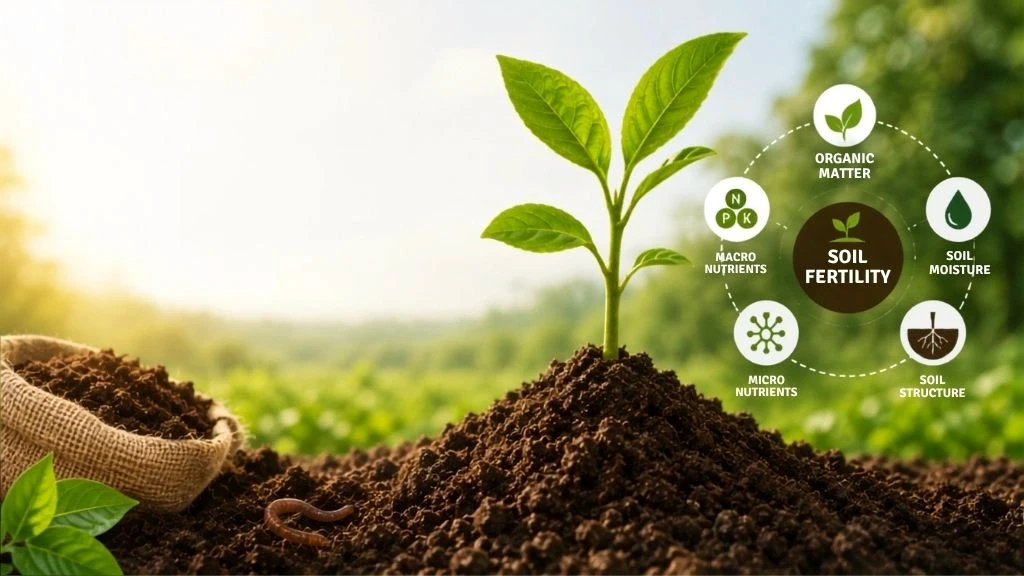
When I first bought my patch of land, I made the classic rookie mistake: I looked at a lush green plot covered in weeds and thought, "Great, this dirt must be super rich."
It took me two ruined seasonal crops and a painful monsoon to realize I was completely wrong.
Green weeds can grow almost anywhere. But actual soil fertility, the kind that grows sweet sugarcane, healthy coffee bushes, or heavy-yielding orchards, is a completely different ballgame underground.
If you are running a managed farmland plot, building a orchard, or just trying to get your farm output up, understanding what is soil fertility isn't just theory. It's what decides whether your land generates a great harvest or drains your bank balance on expensive chemical sprays.
Let's break down how fertile soil actually works, why it matters for Indian farming, and how you can fix bad dirt without losing your mind.
Fun Fact Check
A single teaspoon of fertile Indian topsoil contains more living microorganisms-bacteria, beneficial fungi, and micro-bugs, than there are people on planet Earth! You aren't just farming dirt; you are managing a living subterranean city.
What Is Soil Fertility? Definition & Meaning in Agriculture
Soil fertility is the soil's natural ability to hold onto plant nutrients and feed them to your crops when they actually need them, without toxic chemicals building up or water draining away too fast.
Think of your soil like a fixed bank account.
Nutrients (NPK, Zinc, Organic Carbon) are your cash deposits.
Harvesting crops is making cash withdrawals.
Leaching rains and bad farming are like hidden bank fees wiping out your savings.
If you keep withdrawing without putting organic matter back into the dirt, your soil goes bankrupt. Simple as that.
3 Types of Soil Fertility: Physical, Chemical & Biological
Most people think fertility is just about chemical nitrogen levels. But after years of getting my boots dirty on real farmland, I categorize soil fertility into three distinct types:
Physical Fertility: How the soil feels and holds water. If your clay soil bakes into hard rock during April, or sandy soil loses all its water in five minutes, roots can't breathe or spread, no matter how much fertilizer you throw at it.
Chemical Fertility: This is the actual balance of essential nutrients (like Nitrogen, Phosphorus, Potassium, Calcium) and pH levels.
Biological Fertility: The living ecosystem underground. Earthworms, beneficial mycorrhizal fungi, and soil bacteria that break down dead leaves and convert them into natural plant food.
Factors Affecting Soil Fertility: 4 Key Components to Know
If your crops look yellow or stunted, one of these core factors is out of whack:
1. Organic Matter
Indian soil gets hot. Really hot. Under intense summer heat, soil organic carbon (OC) burns off fast. High organic matter acts like a sponge, it holds onto water during dry spells and feeds underground microbes. If your organic carbon is below 0.75%, your soil will struggle.
2. Soil pH
Most Indian crops prefer a slightly acidic to neutral pH between 6.0 and 7.5. If your soil gets too alkaline (common in dry regions) or too acidic (common in heavy rainfall Malnad belts), your plant roots lock up. They literally starve even if the soil is loaded with fertilizers.
3. Essential Nutrients
Primary Macronutrients: Nitrogen (N) for leafy greens, Phosphorus (P) for deep root systems, and Potassium (K) for disease resistance and fruit size.
Secondary & Micronutrients: Calcium, Magnesium, Sulfur, plus trace minerals like Zinc, Iron, and Boron. In Indian soils, Zinc and Boron deficiencies are huge hidden causes for low crop yields.
4. Soil Texture and Aggregate Structure
Loamy soils, a balanced mix of sand, silt, and clay, are ideal because they drain surplus monsoon water easily while holding enough moisture for plant roots to stay hydrated.
Also Read: Soil Quality Indicators and How to Improve Them
Soil Fertility vs Soil Health: What's the Difference?
People use these two terms interchangeably, but they aren't the same thing:
Feature | Soil Fertility | Soil Health |
Core Focus | Nutrient availability & plant food supply | The whole living ecosystem & long-term sustainability |
Measurement | Lab N-P-K numbers & mineral PPM | Microbial activity, earthworm counts, water infiltration rates |
Quick Fix? | Yes (can be tweaked temporarily with inputs) | No (takes season-after-season of organic soil management) |
Why Is Soil Fertility So Important in Agriculture?
Why should a farmland buyer or grower care so much about this? Because bad soil gets expensive, very fast.
Dramatically Higher Crop Yields: Fertile soils produce heavier, healthier produce that commands better market prices.
Saves Money on Inputs: When your soil biology works for you, you spend way less money buying synthetic fertilizers every month.
Monsoon Drought Resistance: Soil rich in organic carbon stores water deep underground, keeping fruit trees alive even if rains get delayed by weeks.
Environmental & Land Protection: Healthy soil structure prevents precious topsoil from washing away into river streams during heavy tropical downpours.
How to Improve Soil Fertility Naturally: 4 Practical Methods
Fixing degraded soil doesn't happen overnight, but these four practical management steps work wonders on Indian land:
Add Farmyard Manure (FYM) or Jeevamrut: Apply well-rotted cow dung compost, Jeevamrut, or vermicompost before the monsoon starts to rebuild organic carbon.
Grow Cover Crops: Plant legumes like cowpea, velvet bean, or sunn hemp during off-seasons. Their root nodules pull nitrogen directly out of the air and deposit it into your dirt for free.
Mulch Everything: Never leave bare soil exposed to the scorching summer sun. Cover your tree basins with dried leaves, coconut husks, or straw to preserve moisture and protect soil microbes.
Crop Rotation: Stop planting the exact same crop on the same patch year after year. Rotating heavy feeders (like maize or sugarcane) with legumes restores natural fertility cycles.
Final Thoughts: Building Long-Term Soil Fertility
At the end of the day, managing a piece of land isn't about controlling nature with chemicals, it's about working with it. When you build up your soil's physical structure, keep the pH balanced, and feed the living microbes underground, your land repays you with thriving crops and long-term value.
Take a spade out to your land this weekend, dig up a block of dirt, and check for earthworms. That simple check will tell you more about your soil fertility than any fancy sales brochure ever could!
FAQs
1. What is soil fertility and why is it important?
Soil fertility is the natural capacity of soil to supply essential nutrients in balanced amounts for plant growth. It is critical because fertile soil drives higher crop yields, saves money on synthetic fertilizers, and retains water during droughts.
2. What are the main components of soil fertility?
The five primary components are organic matter, balanced soil pH, essential plant nutrients (N-P-K and trace minerals), good physical soil structure, and active soil microbes.
3. How do I know if my farmland soil is fertile?
Look for dark, crumbly soil that smells earthy, drains water easily without pooling for days, and contains plenty of earthworms. A formal lab soil test will confirm your exact organic carbon and nutrient percentages.
4. What causes soil to lose its fertility over time?
Continuous heavy cropping without adding organic matter, excessive chemical fertilizer use, topsoil erosion from rain, over-tilling, and burning crop stubble all destroy natural soil fertility fast.
5. How long does it take to restore infertile soil naturally?
With consistent organic additions like compost, mulching, cover cropping, and reduced tilling, you can see noticeable improvements in soil structure and microbial activity within 1 to 2 seasons.
When I first bought my patch of land, I made the classic rookie mistake: I looked at a lush green plot covered in weeds and thought, "Great, this dirt must be super rich."
It took me two ruined seasonal crops and a painful monsoon to realize I was completely wrong.
Green weeds can grow almost anywhere. But actual soil fertility, the kind that grows sweet sugarcane, healthy coffee bushes, or heavy-yielding orchards, is a completely different ballgame underground.
If you are running a managed farmland plot, building a orchard, or just trying to get your farm output up, understanding what is soil fertility isn't just theory. It's what decides whether your land generates a great harvest or drains your bank balance on expensive chemical sprays.
Let's break down how fertile soil actually works, why it matters for Indian farming, and how you can fix bad dirt without losing your mind.
Fun Fact Check
A single teaspoon of fertile Indian topsoil contains more living microorganisms-bacteria, beneficial fungi, and micro-bugs, than there are people on planet Earth! You aren't just farming dirt; you are managing a living subterranean city.
What Is Soil Fertility? Definition & Meaning in Agriculture
Soil fertility is the soil's natural ability to hold onto plant nutrients and feed them to your crops when they actually need them, without toxic chemicals building up or water draining away too fast.
Think of your soil like a fixed bank account.
Nutrients (NPK, Zinc, Organic Carbon) are your cash deposits.
Harvesting crops is making cash withdrawals.
Leaching rains and bad farming are like hidden bank fees wiping out your savings.
If you keep withdrawing without putting organic matter back into the dirt, your soil goes bankrupt. Simple as that.
3 Types of Soil Fertility: Physical, Chemical & Biological
Most people think fertility is just about chemical nitrogen levels. But after years of getting my boots dirty on real farmland, I categorize soil fertility into three distinct types:
Physical Fertility: How the soil feels and holds water. If your clay soil bakes into hard rock during April, or sandy soil loses all its water in five minutes, roots can't breathe or spread, no matter how much fertilizer you throw at it.
Chemical Fertility: This is the actual balance of essential nutrients (like Nitrogen, Phosphorus, Potassium, Calcium) and pH levels.
Biological Fertility: The living ecosystem underground. Earthworms, beneficial mycorrhizal fungi, and soil bacteria that break down dead leaves and convert them into natural plant food.
Factors Affecting Soil Fertility: 4 Key Components to Know
If your crops look yellow or stunted, one of these core factors is out of whack:
1. Organic Matter
Indian soil gets hot. Really hot. Under intense summer heat, soil organic carbon (OC) burns off fast. High organic matter acts like a sponge, it holds onto water during dry spells and feeds underground microbes. If your organic carbon is below 0.75%, your soil will struggle.
2. Soil pH
Most Indian crops prefer a slightly acidic to neutral pH between 6.0 and 7.5. If your soil gets too alkaline (common in dry regions) or too acidic (common in heavy rainfall Malnad belts), your plant roots lock up. They literally starve even if the soil is loaded with fertilizers.
3. Essential Nutrients
Primary Macronutrients: Nitrogen (N) for leafy greens, Phosphorus (P) for deep root systems, and Potassium (K) for disease resistance and fruit size.
Secondary & Micronutrients: Calcium, Magnesium, Sulfur, plus trace minerals like Zinc, Iron, and Boron. In Indian soils, Zinc and Boron deficiencies are huge hidden causes for low crop yields.
4. Soil Texture and Aggregate Structure
Loamy soils, a balanced mix of sand, silt, and clay, are ideal because they drain surplus monsoon water easily while holding enough moisture for plant roots to stay hydrated.
Also Read: Soil Quality Indicators and How to Improve Them
Soil Fertility vs Soil Health: What's the Difference?
People use these two terms interchangeably, but they aren't the same thing:
Feature | Soil Fertility | Soil Health |
Core Focus | Nutrient availability & plant food supply | The whole living ecosystem & long-term sustainability |
Measurement | Lab N-P-K numbers & mineral PPM | Microbial activity, earthworm counts, water infiltration rates |
Quick Fix? | Yes (can be tweaked temporarily with inputs) | No (takes season-after-season of organic soil management) |
Why Is Soil Fertility So Important in Agriculture?
Why should a farmland buyer or grower care so much about this? Because bad soil gets expensive, very fast.
Dramatically Higher Crop Yields: Fertile soils produce heavier, healthier produce that commands better market prices.
Saves Money on Inputs: When your soil biology works for you, you spend way less money buying synthetic fertilizers every month.
Monsoon Drought Resistance: Soil rich in organic carbon stores water deep underground, keeping fruit trees alive even if rains get delayed by weeks.
Environmental & Land Protection: Healthy soil structure prevents precious topsoil from washing away into river streams during heavy tropical downpours.
How to Improve Soil Fertility Naturally: 4 Practical Methods
Fixing degraded soil doesn't happen overnight, but these four practical management steps work wonders on Indian land:
Add Farmyard Manure (FYM) or Jeevamrut: Apply well-rotted cow dung compost, Jeevamrut, or vermicompost before the monsoon starts to rebuild organic carbon.
Grow Cover Crops: Plant legumes like cowpea, velvet bean, or sunn hemp during off-seasons. Their root nodules pull nitrogen directly out of the air and deposit it into your dirt for free.
Mulch Everything: Never leave bare soil exposed to the scorching summer sun. Cover your tree basins with dried leaves, coconut husks, or straw to preserve moisture and protect soil microbes.
Crop Rotation: Stop planting the exact same crop on the same patch year after year. Rotating heavy feeders (like maize or sugarcane) with legumes restores natural fertility cycles.
Final Thoughts: Building Long-Term Soil Fertility
At the end of the day, managing a piece of land isn't about controlling nature with chemicals, it's about working with it. When you build up your soil's physical structure, keep the pH balanced, and feed the living microbes underground, your land repays you with thriving crops and long-term value.
Take a spade out to your land this weekend, dig up a block of dirt, and check for earthworms. That simple check will tell you more about your soil fertility than any fancy sales brochure ever could!
FAQs
1. What is soil fertility and why is it important?
Soil fertility is the natural capacity of soil to supply essential nutrients in balanced amounts for plant growth. It is critical because fertile soil drives higher crop yields, saves money on synthetic fertilizers, and retains water during droughts.
2. What are the main components of soil fertility?
The five primary components are organic matter, balanced soil pH, essential plant nutrients (N-P-K and trace minerals), good physical soil structure, and active soil microbes.
3. How do I know if my farmland soil is fertile?
Look for dark, crumbly soil that smells earthy, drains water easily without pooling for days, and contains plenty of earthworms. A formal lab soil test will confirm your exact organic carbon and nutrient percentages.
4. What causes soil to lose its fertility over time?
Continuous heavy cropping without adding organic matter, excessive chemical fertilizer use, topsoil erosion from rain, over-tilling, and burning crop stubble all destroy natural soil fertility fast.
5. How long does it take to restore infertile soil naturally?
With consistent organic additions like compost, mulching, cover cropping, and reduced tilling, you can see noticeable improvements in soil structure and microbial activity within 1 to 2 seasons.
Akshata
You Might Also Like


Subscribe to the Swasya
newsletter
Discover insights about sustainable farming, investment opportunities, and the future of agriculture.
By subscribing, you agree to the Privacy Policy
Subscribe to the Swasya
newsletter
Discover insights about sustainable farming, investment opportunities, and the future of agriculture.
By subscribing, you agree to the Privacy Policy