Farming
Top Traditional Indian Farming Tools and How They Are Still Used
30 Sept 2026
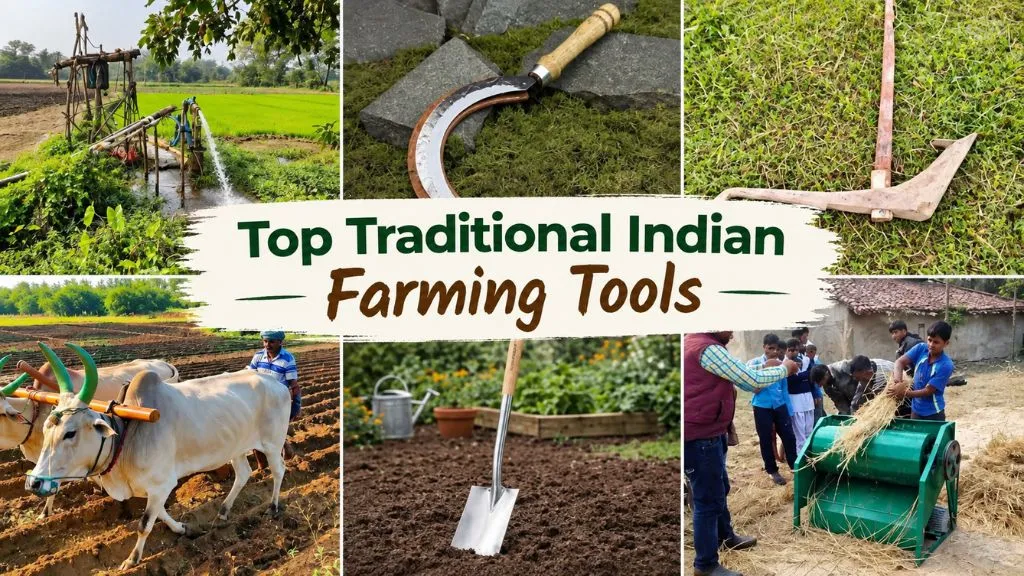
I was at one of our farm sites a few months back, early morning, and there was an older gentleman working a small patch of land with a wooden plough and a pair of bulls. No tractor in sight, not because he couldn't get one there, but because on that little terraced strip, a tractor would've been more trouble than it's worth. That stuck with me.
We talk a lot about "sustainable" this and "eco-friendly" that these days, but here was a guy just doing what his father and grandfather did, and it happened to tick every box we're all chasing now.
That's really what got me thinking about writing this. There's a whole set of old agricultural tools in India that never actually went anywhere, they just quietly kept doing their job while everyone's attention moved to tractors and sprayers.
So here's a rundown of the ones I found most interesting, and why farmers are still reaching for them instead of something newer.
Why bother with old agriculture farming tools when machines exist?
Fair question. A tractor is a big investment, and most Indian farms are small, under two hectares in a lot of cases. If you're working a plot that size, the math on a tractor loan just doesn't work out the way it might for someone farming fifty acres. A plough and a couple of bulls cost far less, and once you've got them, there's no diesel bill either.
Then there's land that simply won't take machinery. Hilly, terraced fields like the ones around our Sakleshpur project, you physically can't get a tractor to turn there the way a person or an ox can. So a lot of these ancient agricultural tools aren't sitting around out of sentiment. They're still the only practical option in places like this.
Not saying every farmer picking up a sickle is thinking about carbon footprints, but the outcome ends up similar either way.
The Plough (Hal)
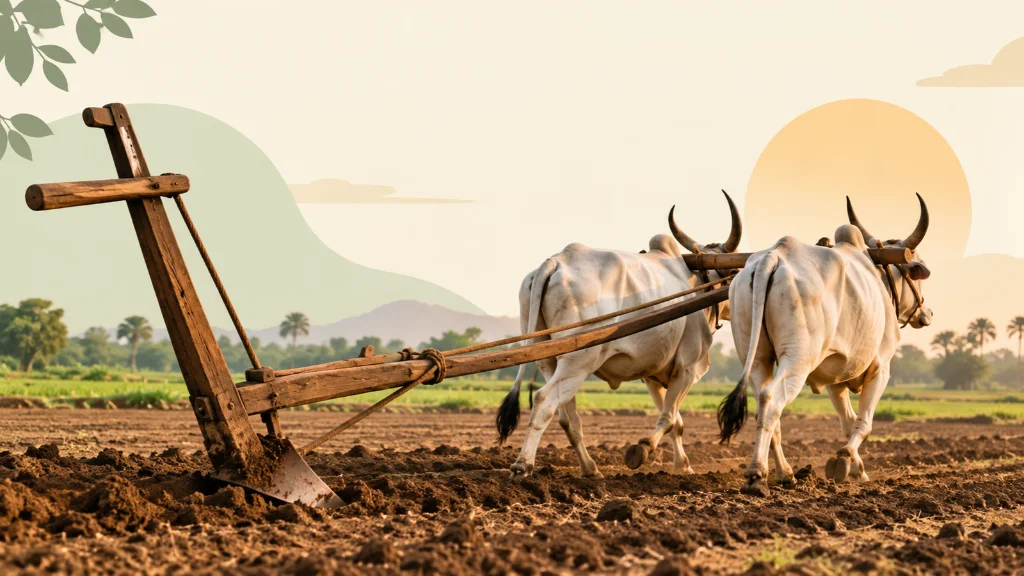
Can't really start anywhere else. The Hal is about as old as farming itself in India, traditionally carved from wood, sometimes fitted with an iron edge now. Farmers pull it behind bulls, or by hand on smaller patches, to break up the soil before sowing.
What I didn't fully appreciate until I read up on it is how much this one tool does. Better aeration, deeper root growth, moisture staying where crops actually need it. A tractor plough obviously does this quicker, but for a small or awkwardly shaped field, the old version still gets the job done just fine.
Scythe
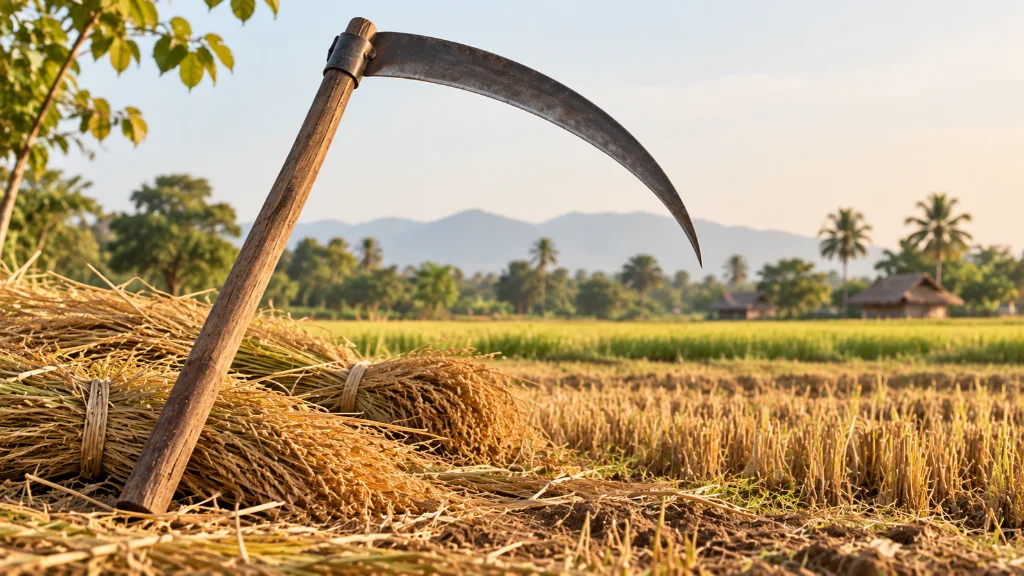
Easy to mix up with the sickle, but it's a different tool with a different job. The scythe has a longer handle and a longer curved blade, meant to be swung with both hands while standing, rather than the crouched, close-to-the-ground motion a sickle needs. It's better suited to cutting tall grass, fodder crops, or clearing overgrown patches quickly, and you'll still see it used on farms that grow feed for cattle. Someone told me once that a good scythe user develops a kind of rhythm with it, almost like a swing you fall into after a while, and I believe that after watching it done properly. It's less common than the sickle these days, but where fodder's involved, it's still the go-to.
Dibble
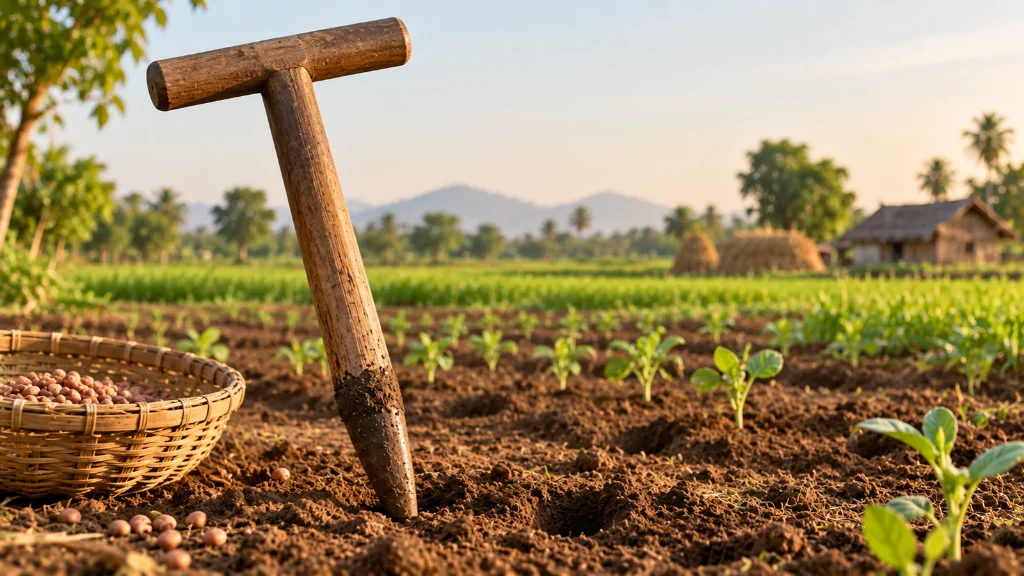
This one's tiny and honestly easy to overlook, but it does a specific job well. A dibble is basically a pointed hand tool, sometimes just a sharpened stick, sometimes a proper wooden or metal implement. It is used to poke small, evenly spaced holes in the soil for planting seeds or seedlings. Vegetable growers and kitchen-garden farmers use it a lot, especially for things like beans, chillies, or transplanting saplings where you need a clean, precise hole rather than a big disturbed patch of soil.
Harrow (Henga)

Comes right after the plough. It's basically a wooden frame with spikes dragged over the field to break up clumps and even the surface before seeds go in. It also helps push weeds down before they get a real foothold, which saves work later.
Sickle (Hasia, or Hansi depending where you're from)
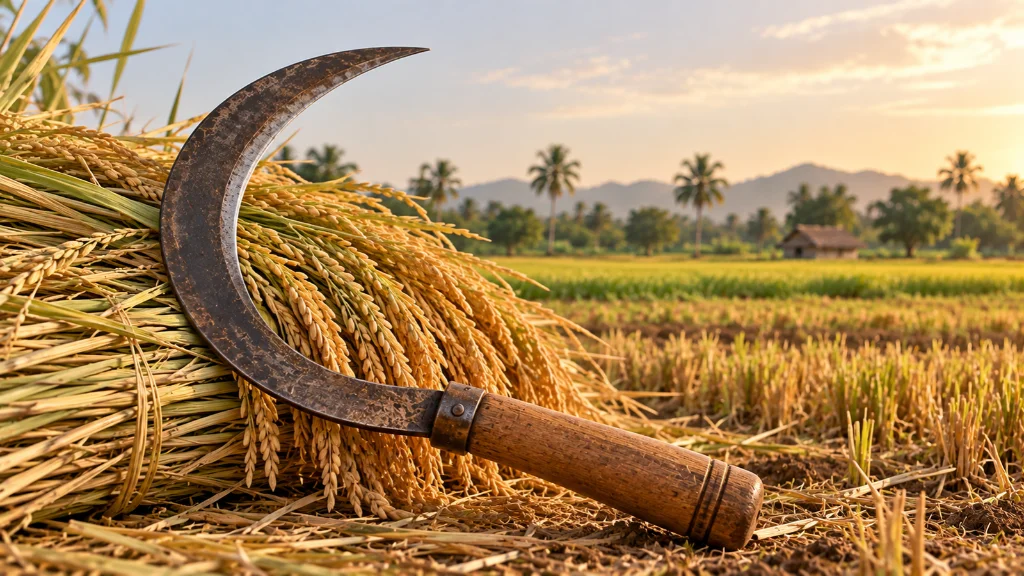
You've probably seen this in a hundred film harvest scenes, curved blade, cuts close to the stalk. What's interesting is how little the design has changed over hundreds of years. It's still one of the most efficient traditional tools used in agriculture because in the right hands it's fast, it doesn't tear up the surrounding plants, and all it needs to stay useful is a bit of sharpening now and then.
Manual Threshers (Dhenki)
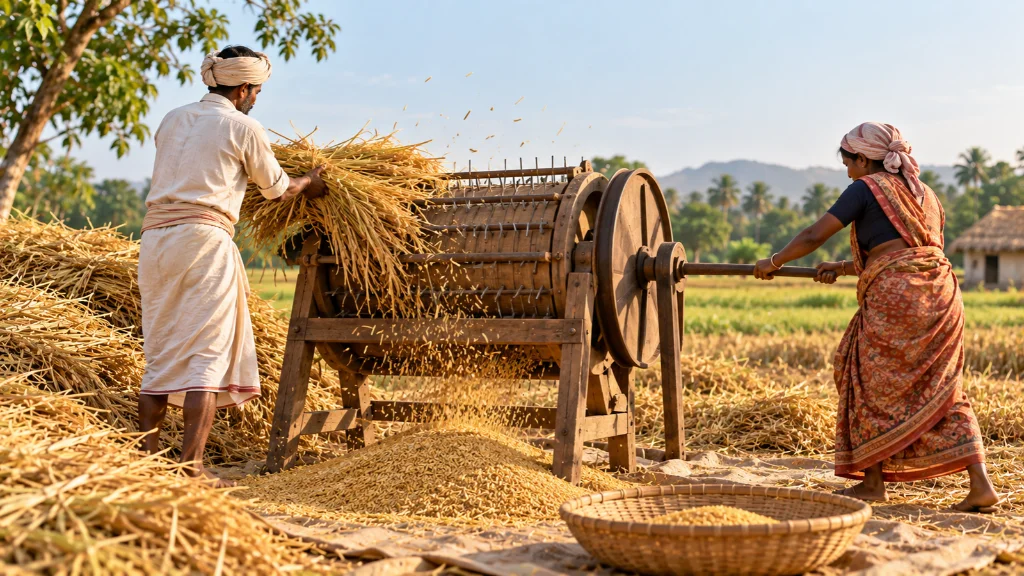
Once the crop's cut, you still need to get the grain off the stalk, and this is where the Dhenki comes in. Usually a foot-powered lever setup. It's slow compared to a mechanical thresher, sure, but it doesn't need electricity, which matters a lot in places where power isn't guaranteed. A few farmers I came across mentioned the grain comes out in better shape too, less crushed than what you sometimes get from machine threshing.
Seed Drill (Beej Bovai Upkaran)
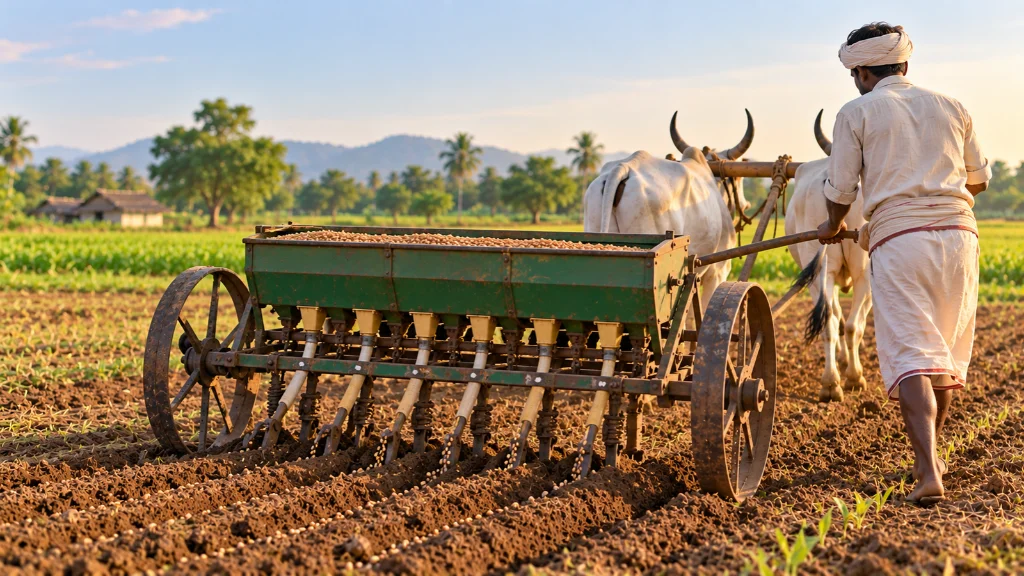
This one genuinely surprised me. Sowing by hand seems simple enough, but you waste seed and end up with uneven spacing. The seed drill fixes that. Plants seeds at a consistent depth and gap, which means better germination and less waste. It's a good reminder that "traditional" doesn't mean unsophisticated. Somebody worked out this problem a long time ago with materials on hand, no engineering degree required.
Traditional Irrigation
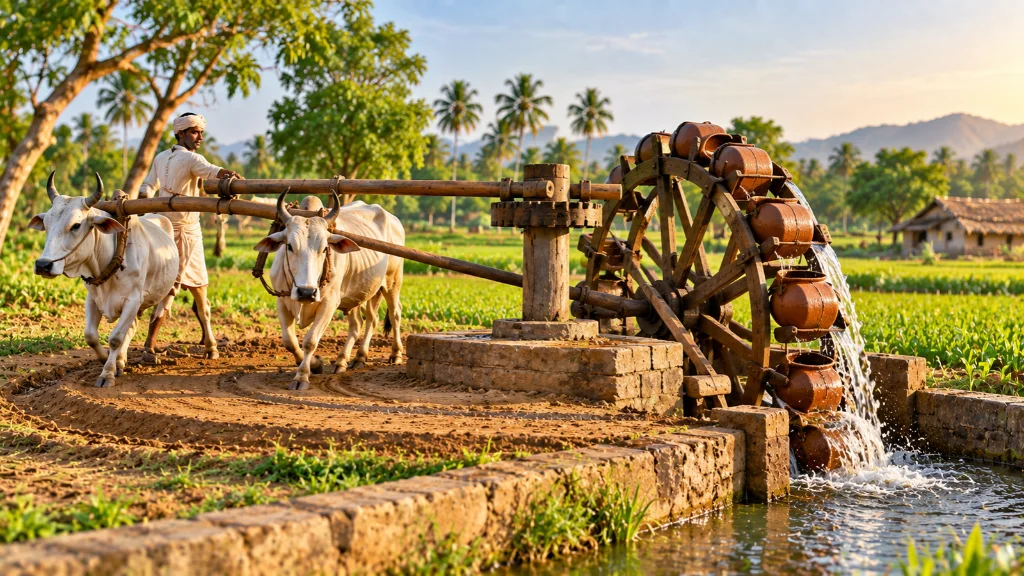
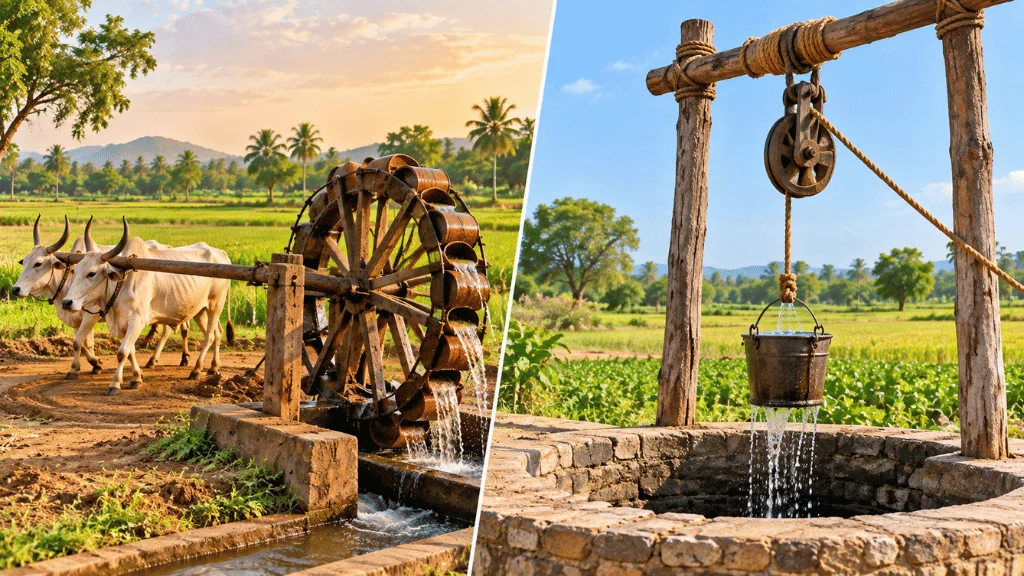
Before pumps and borewells, water moved through fields via earthen canals, wells, and simple lift systems, often powered by hand or animal. In a lot of villages without steady power supply, these traditional irrigation tools are still the main way water gets where it needs to go. And honestly, even in areas with electricity, there's an argument for going back to gravity-fed systems, less strain on the water table, no pump running for hours, lower electricity bill at the end of the month.
Chisel Plough (Cheni Hal)
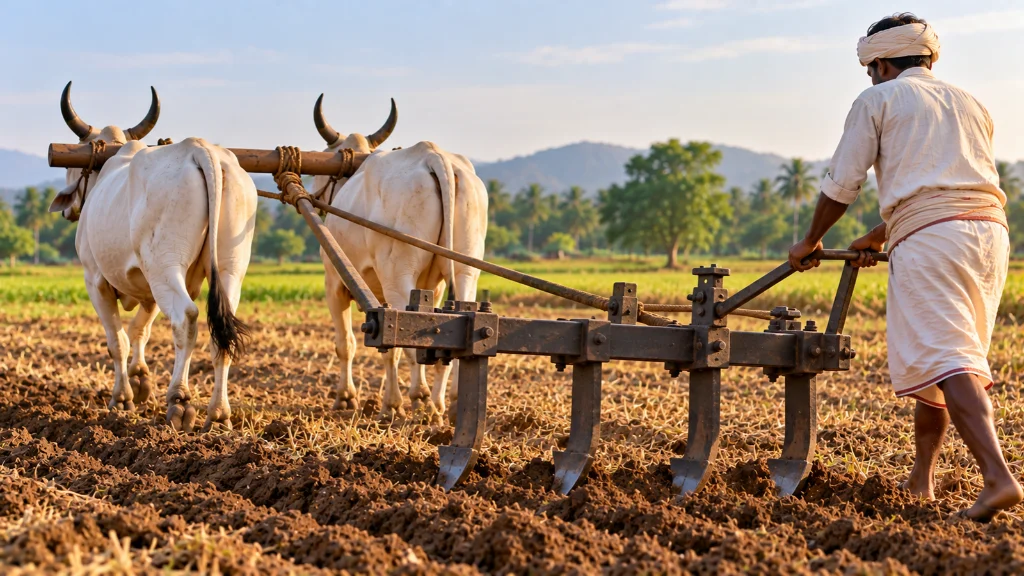
Less commonly mentioned, but this one's built specifically for hard, compacted soil, the kind you get after a dry spell or after tilling the same patch too many times. Unlike a regular plough, it doesn't flip the soil completely, which actually helps water soak in better and cuts down on erosion. Feels like one of those ancient farming implements that gets rediscovered every time someone runs into a stubborn field.
Spade (Fawda)
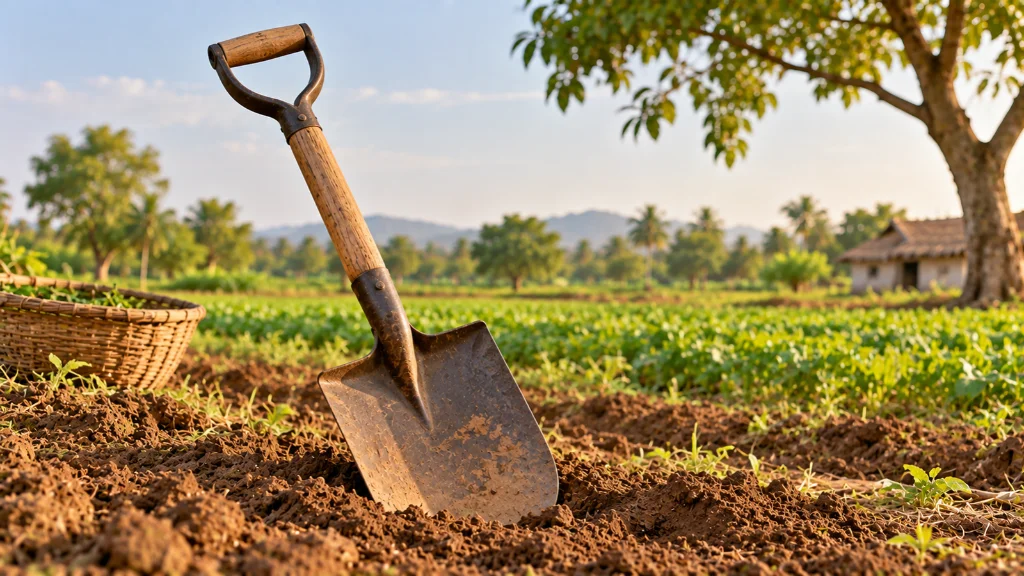
Nothing complicated here, every farm has one, and it does a bit of everything. Digging, turning small patches of soil, clearing weeds. Of all the old agriculture farming tools in India I've come across, the spade is probably the one that's stayed exactly the same, because there's really nothing to improve.
Rake (Jetari)
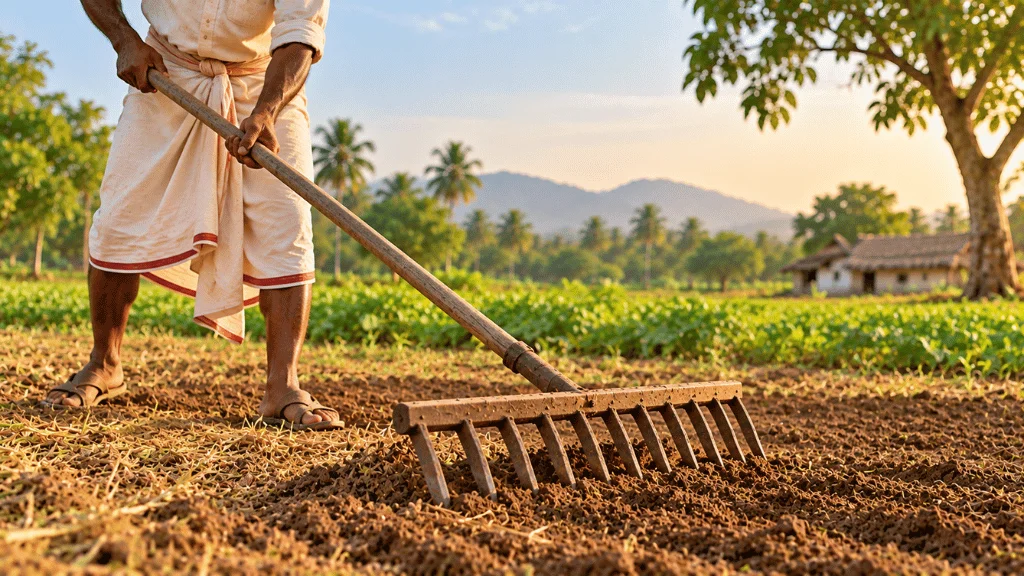
Small tool, does a small job well, gathering loose hay, stubble, and clumps after harvest or during field prep. It's the kind of thing that doesn't get talked about much, but try clearing a field by hand without one and you'll understand why it's stuck around.
Oxen
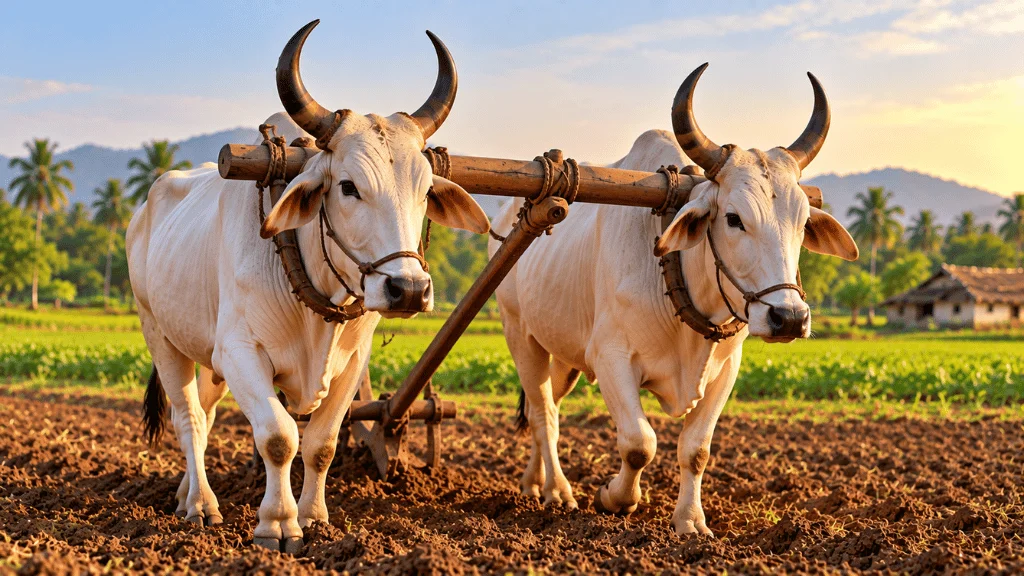
I know, calling an animal a "tool" feels a bit off, but functionally, that's exactly the role bulls have played in Indian farming for thousands of years. Ploughing, hauling carts, drawing water from wells, all of it. No fuel, no engine wear, and unlike a tractor running over the same ground again and again, oxen don't compact the soil the same way. In a lot of villages, a strong, well-kept pair of bulls is still one of the most valuable things a farming family owns.
Natural Pest Control-Neem and Turmeric
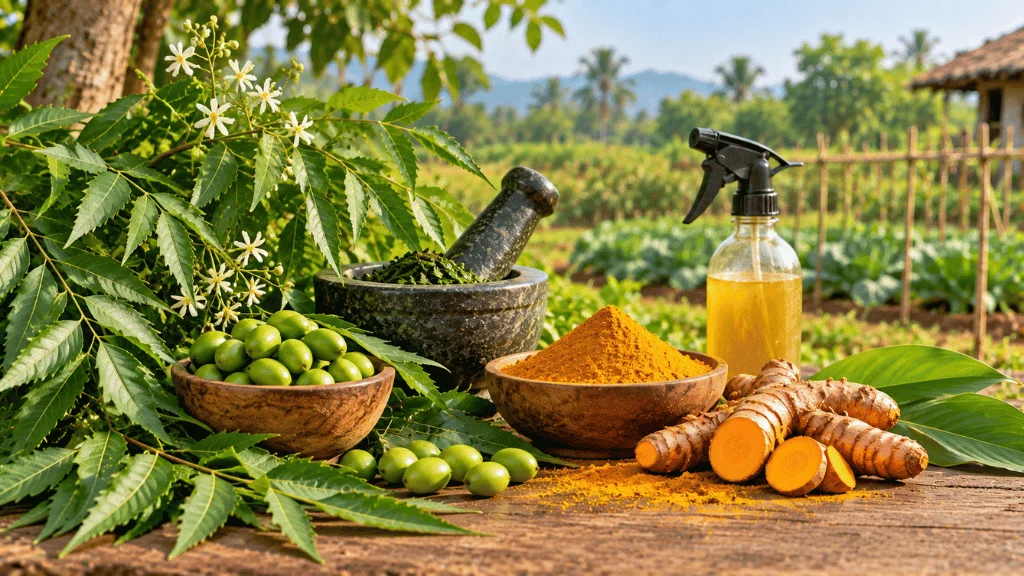
Before pesticides came in bottles, farmers used what was already growing around them. Neem leaves and turmeric have been mixed into natural repellents for generations, keeping pests off without leaving chemical residue in the soil or on the crop. What's interesting is how many organic farms today are circling back to exactly this, not as a nostalgic gesture, but because it works and doesn't harm the insects you actually want around.
Grafting Knife
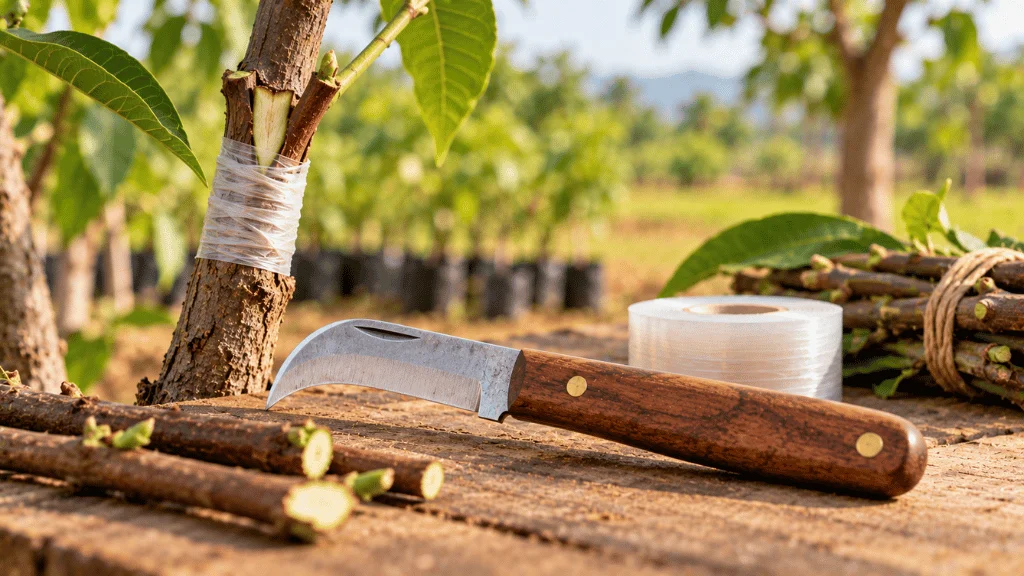
A bit different from the others on this list, since this one's less about tilling or harvesting and more about propagation. A grafting knife has a very sharp, precise blade, single-edged usually, made for slicing clean cuts into stems and rootstock so two plants can be joined together and grown as one. Fruit orchards depend on this heavily, mango, guava, citrus, all commonly grafted this way to get better yield or disease resistance without waiting years for a tree grown from seed to mature. Old-timers who've been doing this for decades can eyeball the angle and get it right almost every time, which is honestly a skill in itself, tool aside.
Ghoomar and Kuhar
Two I hadn't heard of before researching this. The Ghoomar is used for hand-sowing, helps scatter seed more evenly across a field than just tossing it by hand. The Kuhar is a bit different, more of a spinning tool used to make rope and twine from farm fibre rather than anything to do with planting. Not strictly a farming tool, but it's part of the same rural setup, supporting small trades that have existed right alongside agriculture for generations.
What I took away from all this
Looking back at this whole list, there's a pattern that's hard to miss. Nearly every one of these agriculture farming tools used by farmers with names that go back generations shares the same three qualities, cheap to own, no fuel or power needed, and built to work with the land rather than fight it. That's not an accident. Someone who's worked the same patch of soil for thirty, forty years develops a pretty sharp sense for what actually helps it, and what quietly wears it down.
It's honestly the same reasoning behind why we lean toward low-impact, community-based farming at Swasya. There's a lot worth learning from equipment that's survived hundreds of years of daily use, not because nothing better ever came along, but because it never really stopped doing its job well.
So next time you're walking past a field and spot someone with a sickle in hand, or guiding a wooden plough behind a pair of bulls, that's not a step backward. If anything, it might be one of the more sensible ways we've got left of doing this.
FAQs
1. What are the old agricultural tools used in India?
Ploughs, sickles, harrows, spades, and dibbles are among the most common old agricultural tools in India, and many are still used on small farms today.
2. What is the oldest farming tool still in use in India?
The plough, or Hal, is widely considered the oldest and most enduring of India's ancient agricultural tools.
3. What are traditional tools used in agriculture called in different Indian languages?
Names change by region, a sickle is called Hasia or Hansi, a plough is Hal, and a spade is Fawda, but the traditional tools used in agriculture stay largely the same across states.
4. Are ancient farming implements still relevant for modern farmers?
Yes, ancient farming implements remain useful on small, hilly, or terraced land where machinery isn't practical or affordable.
5. What agriculture farming tools do small Indian farmers rely on the most?
Ploughs, sickles, spades, and manual threshers are the agriculture farming tools most small and marginal farmers depend on daily.
I was at one of our farm sites a few months back, early morning, and there was an older gentleman working a small patch of land with a wooden plough and a pair of bulls. No tractor in sight, not because he couldn't get one there, but because on that little terraced strip, a tractor would've been more trouble than it's worth. That stuck with me.
We talk a lot about "sustainable" this and "eco-friendly" that these days, but here was a guy just doing what his father and grandfather did, and it happened to tick every box we're all chasing now.
That's really what got me thinking about writing this. There's a whole set of old agricultural tools in India that never actually went anywhere, they just quietly kept doing their job while everyone's attention moved to tractors and sprayers.
So here's a rundown of the ones I found most interesting, and why farmers are still reaching for them instead of something newer.
Why bother with old agriculture farming tools when machines exist?
Fair question. A tractor is a big investment, and most Indian farms are small, under two hectares in a lot of cases. If you're working a plot that size, the math on a tractor loan just doesn't work out the way it might for someone farming fifty acres. A plough and a couple of bulls cost far less, and once you've got them, there's no diesel bill either.
Then there's land that simply won't take machinery. Hilly, terraced fields like the ones around our Sakleshpur project, you physically can't get a tractor to turn there the way a person or an ox can. So a lot of these ancient agricultural tools aren't sitting around out of sentiment. They're still the only practical option in places like this.
Not saying every farmer picking up a sickle is thinking about carbon footprints, but the outcome ends up similar either way.
The Plough (Hal)
Can't really start anywhere else. The Hal is about as old as farming itself in India, traditionally carved from wood, sometimes fitted with an iron edge now. Farmers pull it behind bulls, or by hand on smaller patches, to break up the soil before sowing.
What I didn't fully appreciate until I read up on it is how much this one tool does. Better aeration, deeper root growth, moisture staying where crops actually need it. A tractor plough obviously does this quicker, but for a small or awkwardly shaped field, the old version still gets the job done just fine.
Scythe
Easy to mix up with the sickle, but it's a different tool with a different job. The scythe has a longer handle and a longer curved blade, meant to be swung with both hands while standing, rather than the crouched, close-to-the-ground motion a sickle needs. It's better suited to cutting tall grass, fodder crops, or clearing overgrown patches quickly, and you'll still see it used on farms that grow feed for cattle. Someone told me once that a good scythe user develops a kind of rhythm with it, almost like a swing you fall into after a while, and I believe that after watching it done properly. It's less common than the sickle these days, but where fodder's involved, it's still the go-to.
Dibble
This one's tiny and honestly easy to overlook, but it does a specific job well. A dibble is basically a pointed hand tool, sometimes just a sharpened stick, sometimes a proper wooden or metal implement. It is used to poke small, evenly spaced holes in the soil for planting seeds or seedlings. Vegetable growers and kitchen-garden farmers use it a lot, especially for things like beans, chillies, or transplanting saplings where you need a clean, precise hole rather than a big disturbed patch of soil.
Harrow (Henga)
Comes right after the plough. It's basically a wooden frame with spikes dragged over the field to break up clumps and even the surface before seeds go in. It also helps push weeds down before they get a real foothold, which saves work later.
Sickle (Hasia, or Hansi depending where you're from)
You've probably seen this in a hundred film harvest scenes, curved blade, cuts close to the stalk. What's interesting is how little the design has changed over hundreds of years. It's still one of the most efficient traditional tools used in agriculture because in the right hands it's fast, it doesn't tear up the surrounding plants, and all it needs to stay useful is a bit of sharpening now and then.
Manual Threshers (Dhenki)
Once the crop's cut, you still need to get the grain off the stalk, and this is where the Dhenki comes in. Usually a foot-powered lever setup. It's slow compared to a mechanical thresher, sure, but it doesn't need electricity, which matters a lot in places where power isn't guaranteed. A few farmers I came across mentioned the grain comes out in better shape too, less crushed than what you sometimes get from machine threshing.
Seed Drill (Beej Bovai Upkaran)
This one genuinely surprised me. Sowing by hand seems simple enough, but you waste seed and end up with uneven spacing. The seed drill fixes that. Plants seeds at a consistent depth and gap, which means better germination and less waste. It's a good reminder that "traditional" doesn't mean unsophisticated. Somebody worked out this problem a long time ago with materials on hand, no engineering degree required.
Traditional Irrigation
Before pumps and borewells, water moved through fields via earthen canals, wells, and simple lift systems, often powered by hand or animal. In a lot of villages without steady power supply, these traditional irrigation tools are still the main way water gets where it needs to go. And honestly, even in areas with electricity, there's an argument for going back to gravity-fed systems, less strain on the water table, no pump running for hours, lower electricity bill at the end of the month.
Chisel Plough (Cheni Hal)
Less commonly mentioned, but this one's built specifically for hard, compacted soil, the kind you get after a dry spell or after tilling the same patch too many times. Unlike a regular plough, it doesn't flip the soil completely, which actually helps water soak in better and cuts down on erosion. Feels like one of those ancient farming implements that gets rediscovered every time someone runs into a stubborn field.
Spade (Fawda)
Nothing complicated here, every farm has one, and it does a bit of everything. Digging, turning small patches of soil, clearing weeds. Of all the old agriculture farming tools in India I've come across, the spade is probably the one that's stayed exactly the same, because there's really nothing to improve.
Rake (Jetari)
Small tool, does a small job well, gathering loose hay, stubble, and clumps after harvest or during field prep. It's the kind of thing that doesn't get talked about much, but try clearing a field by hand without one and you'll understand why it's stuck around.
Oxen
I know, calling an animal a "tool" feels a bit off, but functionally, that's exactly the role bulls have played in Indian farming for thousands of years. Ploughing, hauling carts, drawing water from wells, all of it. No fuel, no engine wear, and unlike a tractor running over the same ground again and again, oxen don't compact the soil the same way. In a lot of villages, a strong, well-kept pair of bulls is still one of the most valuable things a farming family owns.
Natural Pest Control-Neem and Turmeric
Before pesticides came in bottles, farmers used what was already growing around them. Neem leaves and turmeric have been mixed into natural repellents for generations, keeping pests off without leaving chemical residue in the soil or on the crop. What's interesting is how many organic farms today are circling back to exactly this, not as a nostalgic gesture, but because it works and doesn't harm the insects you actually want around.
Grafting Knife
A bit different from the others on this list, since this one's less about tilling or harvesting and more about propagation. A grafting knife has a very sharp, precise blade, single-edged usually, made for slicing clean cuts into stems and rootstock so two plants can be joined together and grown as one. Fruit orchards depend on this heavily, mango, guava, citrus, all commonly grafted this way to get better yield or disease resistance without waiting years for a tree grown from seed to mature. Old-timers who've been doing this for decades can eyeball the angle and get it right almost every time, which is honestly a skill in itself, tool aside.
Ghoomar and Kuhar
Two I hadn't heard of before researching this. The Ghoomar is used for hand-sowing, helps scatter seed more evenly across a field than just tossing it by hand. The Kuhar is a bit different, more of a spinning tool used to make rope and twine from farm fibre rather than anything to do with planting. Not strictly a farming tool, but it's part of the same rural setup, supporting small trades that have existed right alongside agriculture for generations.
What I took away from all this
Looking back at this whole list, there's a pattern that's hard to miss. Nearly every one of these agriculture farming tools used by farmers with names that go back generations shares the same three qualities, cheap to own, no fuel or power needed, and built to work with the land rather than fight it. That's not an accident. Someone who's worked the same patch of soil for thirty, forty years develops a pretty sharp sense for what actually helps it, and what quietly wears it down.
It's honestly the same reasoning behind why we lean toward low-impact, community-based farming at Swasya. There's a lot worth learning from equipment that's survived hundreds of years of daily use, not because nothing better ever came along, but because it never really stopped doing its job well.
So next time you're walking past a field and spot someone with a sickle in hand, or guiding a wooden plough behind a pair of bulls, that's not a step backward. If anything, it might be one of the more sensible ways we've got left of doing this.
FAQs
1. What are the old agricultural tools used in India?
Ploughs, sickles, harrows, spades, and dibbles are among the most common old agricultural tools in India, and many are still used on small farms today.
2. What is the oldest farming tool still in use in India?
The plough, or Hal, is widely considered the oldest and most enduring of India's ancient agricultural tools.
3. What are traditional tools used in agriculture called in different Indian languages?
Names change by region, a sickle is called Hasia or Hansi, a plough is Hal, and a spade is Fawda, but the traditional tools used in agriculture stay largely the same across states.
4. Are ancient farming implements still relevant for modern farmers?
Yes, ancient farming implements remain useful on small, hilly, or terraced land where machinery isn't practical or affordable.
5. What agriculture farming tools do small Indian farmers rely on the most?
Ploughs, sickles, spades, and manual threshers are the agriculture farming tools most small and marginal farmers depend on daily.
Akshata
You Might Also Like

Subscribe to the Swasya
newsletter
Discover insights about sustainable farming, investment opportunities, and the future of agriculture.
By subscribing, you agree to the Privacy Policy
Subscribe to the Swasya
newsletter
Discover insights about sustainable farming, investment opportunities, and the future of agriculture.
By subscribing, you agree to the Privacy Policy