Farming
Drip vs Sprinkler Irrigation: Differences, Benefits & Uses
17 Sept 2026

Watering crops sounds simple. Until you actually have a farm.
Choosing the right irrigation system can affect how efficiently water reaches your crops. Two common options are drip irrigation and sprinkler irrigation, but they work in very different ways.
Drip irrigation delivers water close to the plant's root zone, while sprinkler irrigation distributes water over a wider area. The right choice depends on factors such as crop type, soil, land size, water availability, field layout and installation requirements.
In this guide, we compare drip irrigation vs sprinkler irrigation, including their benefits, limitations, water use, maintenance needs and suitability for different types of farms.
What Is Drip Irrigation and How Does It Work?
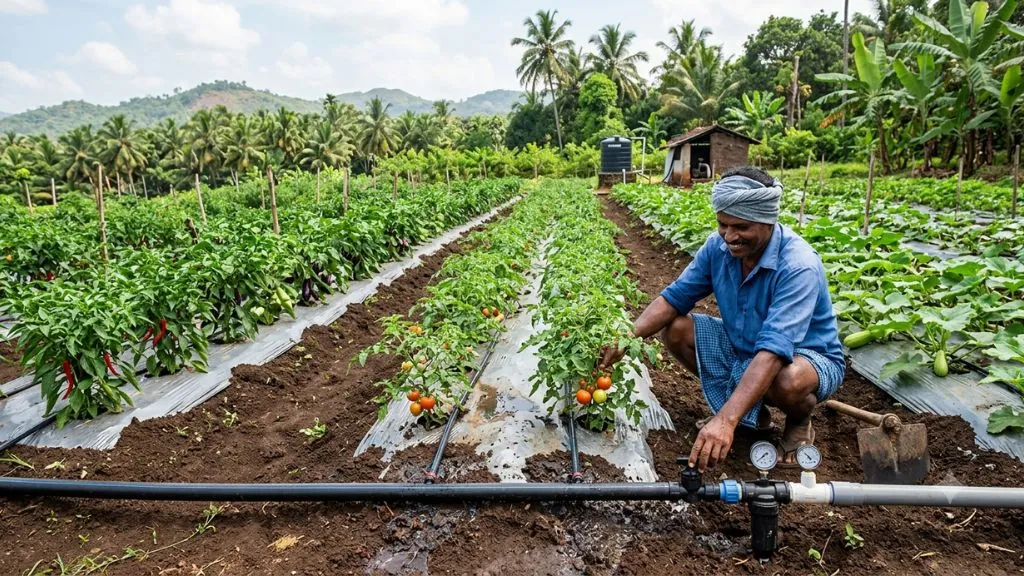
Instead of throwing water across the entire field, drip irrigation slowly delivers water closer to the plant’s roots.
Small pipes or tubes are laid along the crop rows. Water passes through tiny outlets called emitters and reaches the soil near the plant.
What Are the Benefits of Drip Irrigation?
The main drip irrigation benefits come down to better control and less water wastage. Water is supplied directly to the root zone instead of wetting the entire field.
This can be especially useful for:
Vegetables
Fruits
Sugarcane
Plantation crops
Orchards
For example, if you are growing rows of tomatoes, you don't necessarily need to wet all the soil between those rows. The plants need water. Not every inch of the farm.
That’s where drip systems make a lot of sense.
Another advantage is that fertilizers can also be supplied through the irrigation system when the setup is designed for fertigation.
So, water and nutrients can reach the crop together. Pretty practical, actually.
What Are the Limitations of Drip Irrigation?
This part is often skipped when people talk about the benefits. A drip system needs attention.
The small emitters can get clogged, especially when the water contains dirt or other particles. Good filtration is therefore important.
The pipes also need to be laid properly. If the system isn't designed according to the crop and field, you may not get the uniform watering you expected.
And yes, there is maintenance involved.
So, don't just install the pipes and forget about them.
What Is Sprinkler Irrigation and How Does It Work?
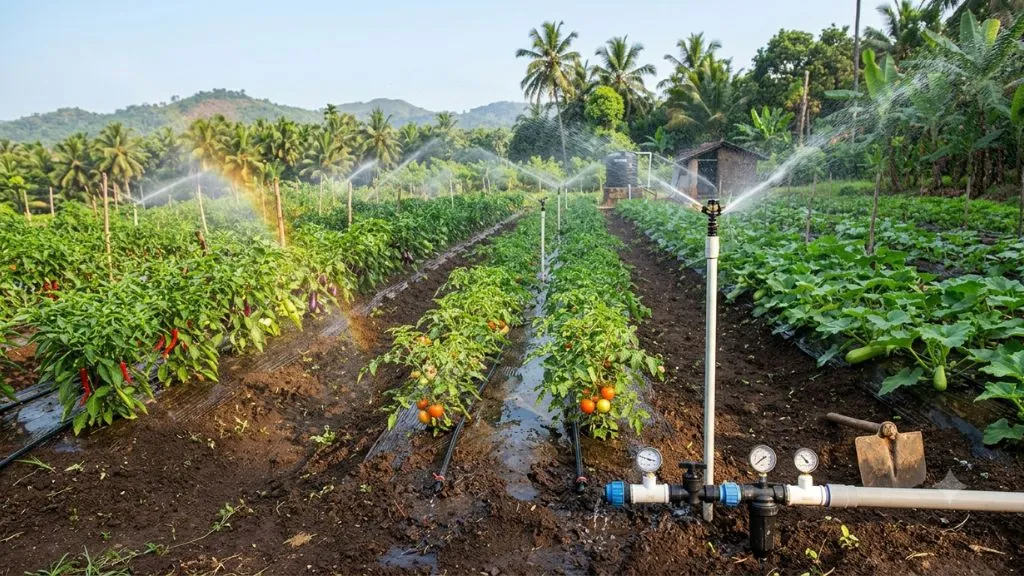
Now imagine watering your field almost like rainfall. That is basically the idea behind sprinkler irrigation.
Water is pushed through pipes and released through sprinkler heads. The water is sprayed into the air and falls over the crop and soil.
Unlike drip systems, the water isn't delivered to one specific plant. A larger area gets covered at once.
This makes sprinkler irrigation useful for open fields and crops where broad, fairly uniform watering is needed. It can also be helpful when the land isn't perfectly level.
What Are the Benefits of Sprinkler Irrigation?
The biggest sprinkler irrigation benefits are coverage and flexibility.
A properly designed sprinkler system can cover a large area without requiring individual water outlets for every plant.
It can work well for:
Field crops
Lawns and open landscapes
Fodder crops
Vegetables
Nurseries
Large agricultural fields
The setup can also be changed or moved depending on the farm.
That flexibility can be useful when you're dealing with different crops or changing layouts.
Drip Irrigation vs Sprinkler Irrigation: Key Differences
The biggest difference between drip and sprinkler irrigation systems is simply how the water reaches the crop.
With drip, water is delivered close to the roots.
With sprinklers, water is sprayed over a wider area.
Here’s a quick comparison:
Factor | Drip Irrigation | Sprinkler Irrigation |
Water delivery | Directly near roots | Sprayed over the crop/soil |
Water coverage | Targeted | Wide area |
Water efficiency | Generally higher | Generally moderate |
Best suited for | Fruits, vegetables, orchards | Field crops and larger open areas |
Wind sensitivity | Low | Higher |
Maintenance | Filtration and flushing required | Pressure and sprinkler maintenance required |
Flexibility | More fixed | More flexible |
So, when you're looking at drip irrigation vs sprinkler irrigation, don't just ask which system is “better.” Ask which one makes more sense for your farm.
Also read: Hydroponics vs Aquaponics: Key Differences
Which Irrigation System Is Better for Different Crops?
If You Grow Vegetables- Drip is usually a strong option.
Vegetables are often planted in rows, making it easier to place drip lines close to the plants. Water can be supplied exactly where it is needed.
For crops such as tomatoes, chillies, brinjal and many other vegetables, this targeted approach can be useful.
If You Have an Orchard- Again, drip can be a good choice.
Fruit trees don't need the entire field to be soaked every time. Water can be directed towards the root zone of individual trees. This is one situation where the precision of drip irrigation really stands out.
If You Grow Field Crops- This is where sprinklers can have an advantage.
If you have a large open field with crops that need broader coverage, a sprinkler system can save you from installing long rows of drip lines everywhere.
The water is distributed over a wider area.
Which Irrigation System Is Better for Uneven Land?
Sprinklers can be useful on uneven land because they don't depend entirely on water flowing along the soil surface.
But the system still needs to be designed properly. Pressure matters. If it isn't balanced, some parts of the field may receive more water than others.
Which Irrigation System Uses Less Water?
This is probably the question most farmers have. And rightly so.
Water isn't something you want to waste. In general, drip irrigation offers more precise water application because the water is delivered close to the plant roots.
Sprinklers can also be efficient when they are correctly designed and operated, but water can be lost through evaporation and wind drift.
I've seen this become particularly noticeable when sprinklers are used on hot or windy days.
So, if water conservation is your biggest priority and your crops suit the system, drip is worth considering.
What Components Do Drip and Sprinkler Irrigation Systems Need?
The irrigation method is only one part of the setup. The quality of the components matters too.
A good irrigation system usually needs things such as:
Pipes and drip lines
Sprinkler heads
Emitters
Filters
Valves
Tees and elbows
Couplers and connectors
A poor-quality fitting can turn into a small headache later. A clogged filter can affect the whole system. And incorrect pressure can mess with water distribution.
This is why choosing the right components and getting the system designed properly is just as important as choosing between drip and sprinklers.
The idea is simple: the better the system is designed and maintained, the better it can perform.
Can You Use Drip and Sprinkler Irrigation on the Same Farm?
Yes. You don't necessarily have to choose only one.
A farm may use drip for vegetables or fruit trees and sprinklers for larger open areas. For example, imagine a farm with an orchard on one side and a field crop on the other.
There is no reason both areas have to be irrigated in exactly the same way. The crops have different needs. The irrigation system can reflect that. In fact, sometimes this is the most practical approach.
Common Irrigation Mistakes Farmers Should Avoid
Choosing a system only because someone else is using it is one. Every farm is different.
Another common mistake is ignoring filtration. This is especially important for drip systems because clogged emitters can affect water delivery.
Poor system layout is another one. You could have excellent irrigation equipment, but if the design is wrong, the results won't be great.
And finally, don't look only at the initial installation cost. Think about maintenance, water usage, crop requirements and long-term performance too. A cheaper system that constantly needs repairs isn't necessarily cheaper in the long run.
Also Check: What Is Soil Fertility& How to Improve it?
Drip vs Sprinkler Irrigation: Which One Should You Choose?
If you ask me to put it simply:
Choose drip irrigation when you want precise watering and better control around individual plants.
Choose sprinkler irrigation when you need wider coverage across an open area.
That's really the heart of the sprinkler vs drip irrigation difference.
The right choice depends on your crop, soil, land size, water availability and farm layout. And honestly, that's a much better way to look at drip irrigation vs sprinkler irrigation.
Don't choose the system first. Understand what your farm actually needs. Then choose the irrigation system around it.
FAQs
1. Which is better, drip or sprinkler irrigation?
It depends on the crop and farm. Drip is generally better for targeted watering, while sprinklers are useful when wider field coverage is required.
2. Is drip irrigation more water-efficient than sprinkler irrigation?
Generally, yes. Drip delivers water closer to the roots, which can reduce losses from evaporation and unnecessary wetting.
3. Which irrigation system is best for vegetable crops?
Drip is often preferred for vegetables because water can be supplied directly to the root zone of plants.
4. Can sprinkler irrigation be used on uneven land?
Yes. Sprinklers can work on uneven land, although proper pressure and system design are important for uniform water distribution.
5. Can drip and sprinkler irrigation be used on the same farm?
Yes. Many farms use drip for orchards or vegetables and sprinklers for larger open fields, depending on crop requirements.
6. Does drip irrigation require a filter?
Yes. Filtration is important because dirt and particles in the water can clog drip emitters and affect water flow.
Watering crops sounds simple. Until you actually have a farm.
Choosing the right irrigation system can affect how efficiently water reaches your crops. Two common options are drip irrigation and sprinkler irrigation, but they work in very different ways.
Drip irrigation delivers water close to the plant's root zone, while sprinkler irrigation distributes water over a wider area. The right choice depends on factors such as crop type, soil, land size, water availability, field layout and installation requirements.
In this guide, we compare drip irrigation vs sprinkler irrigation, including their benefits, limitations, water use, maintenance needs and suitability for different types of farms.
What Is Drip Irrigation and How Does It Work?
Instead of throwing water across the entire field, drip irrigation slowly delivers water closer to the plant’s roots.
Small pipes or tubes are laid along the crop rows. Water passes through tiny outlets called emitters and reaches the soil near the plant.
What Are the Benefits of Drip Irrigation?
The main drip irrigation benefits come down to better control and less water wastage. Water is supplied directly to the root zone instead of wetting the entire field.
This can be especially useful for:
Vegetables
Fruits
Sugarcane
Plantation crops
Orchards
For example, if you are growing rows of tomatoes, you don't necessarily need to wet all the soil between those rows. The plants need water. Not every inch of the farm.
That’s where drip systems make a lot of sense.
Another advantage is that fertilizers can also be supplied through the irrigation system when the setup is designed for fertigation.
So, water and nutrients can reach the crop together. Pretty practical, actually.
What Are the Limitations of Drip Irrigation?
This part is often skipped when people talk about the benefits. A drip system needs attention.
The small emitters can get clogged, especially when the water contains dirt or other particles. Good filtration is therefore important.
The pipes also need to be laid properly. If the system isn't designed according to the crop and field, you may not get the uniform watering you expected.
And yes, there is maintenance involved.
So, don't just install the pipes and forget about them.
What Is Sprinkler Irrigation and How Does It Work?
Now imagine watering your field almost like rainfall. That is basically the idea behind sprinkler irrigation.
Water is pushed through pipes and released through sprinkler heads. The water is sprayed into the air and falls over the crop and soil.
Unlike drip systems, the water isn't delivered to one specific plant. A larger area gets covered at once.
This makes sprinkler irrigation useful for open fields and crops where broad, fairly uniform watering is needed. It can also be helpful when the land isn't perfectly level.
What Are the Benefits of Sprinkler Irrigation?
The biggest sprinkler irrigation benefits are coverage and flexibility.
A properly designed sprinkler system can cover a large area without requiring individual water outlets for every plant.
It can work well for:
Field crops
Lawns and open landscapes
Fodder crops
Vegetables
Nurseries
Large agricultural fields
The setup can also be changed or moved depending on the farm.
That flexibility can be useful when you're dealing with different crops or changing layouts.
Drip Irrigation vs Sprinkler Irrigation: Key Differences
The biggest difference between drip and sprinkler irrigation systems is simply how the water reaches the crop.
With drip, water is delivered close to the roots.
With sprinklers, water is sprayed over a wider area.
Here’s a quick comparison:
Factor | Drip Irrigation | Sprinkler Irrigation |
Water delivery | Directly near roots | Sprayed over the crop/soil |
Water coverage | Targeted | Wide area |
Water efficiency | Generally higher | Generally moderate |
Best suited for | Fruits, vegetables, orchards | Field crops and larger open areas |
Wind sensitivity | Low | Higher |
Maintenance | Filtration and flushing required | Pressure and sprinkler maintenance required |
Flexibility | More fixed | More flexible |
So, when you're looking at drip irrigation vs sprinkler irrigation, don't just ask which system is “better.” Ask which one makes more sense for your farm.
Also read: Hydroponics vs Aquaponics: Key Differences
Which Irrigation System Is Better for Different Crops?
If You Grow Vegetables- Drip is usually a strong option.
Vegetables are often planted in rows, making it easier to place drip lines close to the plants. Water can be supplied exactly where it is needed.
For crops such as tomatoes, chillies, brinjal and many other vegetables, this targeted approach can be useful.
If You Have an Orchard- Again, drip can be a good choice.
Fruit trees don't need the entire field to be soaked every time. Water can be directed towards the root zone of individual trees. This is one situation where the precision of drip irrigation really stands out.
If You Grow Field Crops- This is where sprinklers can have an advantage.
If you have a large open field with crops that need broader coverage, a sprinkler system can save you from installing long rows of drip lines everywhere.
The water is distributed over a wider area.
Which Irrigation System Is Better for Uneven Land?
Sprinklers can be useful on uneven land because they don't depend entirely on water flowing along the soil surface.
But the system still needs to be designed properly. Pressure matters. If it isn't balanced, some parts of the field may receive more water than others.
Which Irrigation System Uses Less Water?
This is probably the question most farmers have. And rightly so.
Water isn't something you want to waste. In general, drip irrigation offers more precise water application because the water is delivered close to the plant roots.
Sprinklers can also be efficient when they are correctly designed and operated, but water can be lost through evaporation and wind drift.
I've seen this become particularly noticeable when sprinklers are used on hot or windy days.
So, if water conservation is your biggest priority and your crops suit the system, drip is worth considering.
What Components Do Drip and Sprinkler Irrigation Systems Need?
The irrigation method is only one part of the setup. The quality of the components matters too.
A good irrigation system usually needs things such as:
Pipes and drip lines
Sprinkler heads
Emitters
Filters
Valves
Tees and elbows
Couplers and connectors
A poor-quality fitting can turn into a small headache later. A clogged filter can affect the whole system. And incorrect pressure can mess with water distribution.
This is why choosing the right components and getting the system designed properly is just as important as choosing between drip and sprinklers.
The idea is simple: the better the system is designed and maintained, the better it can perform.
Can You Use Drip and Sprinkler Irrigation on the Same Farm?
Yes. You don't necessarily have to choose only one.
A farm may use drip for vegetables or fruit trees and sprinklers for larger open areas. For example, imagine a farm with an orchard on one side and a field crop on the other.
There is no reason both areas have to be irrigated in exactly the same way. The crops have different needs. The irrigation system can reflect that. In fact, sometimes this is the most practical approach.
Common Irrigation Mistakes Farmers Should Avoid
Choosing a system only because someone else is using it is one. Every farm is different.
Another common mistake is ignoring filtration. This is especially important for drip systems because clogged emitters can affect water delivery.
Poor system layout is another one. You could have excellent irrigation equipment, but if the design is wrong, the results won't be great.
And finally, don't look only at the initial installation cost. Think about maintenance, water usage, crop requirements and long-term performance too. A cheaper system that constantly needs repairs isn't necessarily cheaper in the long run.
Also Check: What Is Soil Fertility& How to Improve it?
Drip vs Sprinkler Irrigation: Which One Should You Choose?
If you ask me to put it simply:
Choose drip irrigation when you want precise watering and better control around individual plants.
Choose sprinkler irrigation when you need wider coverage across an open area.
That's really the heart of the sprinkler vs drip irrigation difference.
The right choice depends on your crop, soil, land size, water availability and farm layout. And honestly, that's a much better way to look at drip irrigation vs sprinkler irrigation.
Don't choose the system first. Understand what your farm actually needs. Then choose the irrigation system around it.
FAQs
1. Which is better, drip or sprinkler irrigation?
It depends on the crop and farm. Drip is generally better for targeted watering, while sprinklers are useful when wider field coverage is required.
2. Is drip irrigation more water-efficient than sprinkler irrigation?
Generally, yes. Drip delivers water closer to the roots, which can reduce losses from evaporation and unnecessary wetting.
3. Which irrigation system is best for vegetable crops?
Drip is often preferred for vegetables because water can be supplied directly to the root zone of plants.
4. Can sprinkler irrigation be used on uneven land?
Yes. Sprinklers can work on uneven land, although proper pressure and system design are important for uniform water distribution.
5. Can drip and sprinkler irrigation be used on the same farm?
Yes. Many farms use drip for orchards or vegetables and sprinklers for larger open fields, depending on crop requirements.
6. Does drip irrigation require a filter?
Yes. Filtration is important because dirt and particles in the water can clog drip emitters and affect water flow.
Akshata
You Might Also Like

Subscribe to the Swasya
newsletter
Discover insights about sustainable farming, investment opportunities, and the future of agriculture.
By subscribing, you agree to the Privacy Policy
Subscribe to the Swasya
newsletter
Discover insights about sustainable farming, investment opportunities, and the future of agriculture.
By subscribing, you agree to the Privacy Policy