Farming
Mango Farming in India 2026: Yield & Profit Per Acre
22 Sept 2026
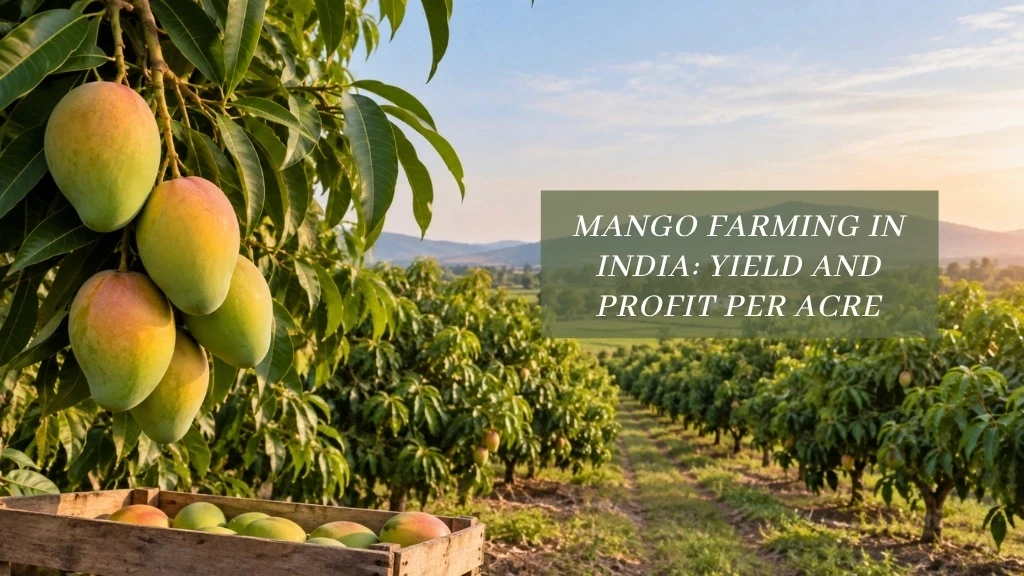
Mango farming sounds simple until you start looking at the numbers. You plant the trees, take care of them, wait for them to grow, and eventually, the orchard starts giving you fruit. But that “eventually” is important.
Mango trees don't become productive overnight.
If you are considering mango farming in India, you need to look at the full picture. The number of trees you can plant, expected yield, maintenance costs, market prices and, of course, how many years you may have to wait before the orchard starts generating meaningful income.
The good thing is that mango is a long-term crop. A well-maintained orchard can keep producing for many years.
So, let's look at what one acre of mango farming can actually look like in 2026.
How Many Mangoes Can be Produced in an Acre ?
There isn't one fixed answer to mango yield per acre. It depends on the variety, age of the trees, spacing, soil, irrigation, weather and how well the orchard is managed.
A traditional mango orchard may have around 40 to 60 trees per acre. With high-density planting, considerably more trees can be accommodated in the same space.
A mature orchard can produce a few tonnes of mangoes per acre in a good season. Under high-density systems, the yield can be considerably higher.
But here's something worth remembering.
A higher number on paper doesn't automatically mean higher profit.
More trees also mean more pruning, irrigation, fertilisation, pest management and closer monitoring.
How Many Mango Trees Can You Plant Per Acre?
This is one of the first questions people ask when planning a mango plantation. The answer depends mainly on the planting system.
With traditional spacing, you may have around 40 to 60 mango trees per acre.
High-density planting allows more trees to be grown in the same area. Some intensive systems can accommodate hundreds of trees per acre.
The spacing is usually decided based on the variety and the expected size of the mature tree.
You don't want an orchard where the trees are fighting each other for sunlight and air.
That defeats the purpose.
For a long-term plantation, the layout has to be planned before the first sapling goes into the ground.
When Does a Mango Orchard Start Giving Returns?
This is probably the part people should think about more carefully. Mango farming is not a quick-return crop.
Young trees need time to establish themselves. Depending on the variety and planting system, the first commercial harvest may begin around the fourth to sixth year.
The trees become significantly more productive as they mature.
So, if you are calculating mango farming profit per acre, don't take the income from a mature orchard and apply it to the first few years.
That's where many online calculations become misleading. The early years are mostly about spending.
Land preparation. Saplings. Irrigation. Fertiliser. Labour. Pest management.
The income comes later. And that's okay, as long as you go into it knowing that mango is a long-term plantation.
What Affects Mango Yield Per Acre?
Two mango orchards of the same size can produce very different results.
Why? Because yield isn't decided by land size alone.
A few things make a big difference.
Mango Variety
Alphonso, Kesar, Dasheri, Banganapalli and other varieties have different growth patterns, yields and market prices.
Some varieties also command better prices when sold in the right market.
Planting Density
The number of trees matters. Traditional orchards have fewer trees with more space between them. High-density plantations use land more intensively.
However, more trees require more careful management.
Irrigation
Young mango trees especially need reliable water during their establishment period.
Drip irrigation is often used in plantations because water can be supplied close to the root zone.
Good irrigation doesn't mean flooding the orchard. It means giving the trees what they need, when they need it.
Soil and Weather
Mango can grow in different parts of India, but the local climate still matters.
Temperature, rainfall, soil drainage and water availability can all affect flowering and fruit development.
And then there is the one thing nobody can control completely, weather. A particularly bad season can affect production even in a well-managed orchard.
Where Is Mango Grown in India?
If you've ever wondered where is mango grown in India, the answer is: in many parts of the country.
Mango cultivation is spread across several states, including Maharashtra, Karnataka, Andhra Pradesh, Telangana, Uttar Pradesh, Bihar, Gujarat and Tamil Nadu.
Different regions have become known for different varieties.
Maharashtra is strongly associated with Alphonso. Uttar Pradesh is known for varieties such as Dasheri. Karnataka and Andhra Pradesh are also major mango-growing regions.
The local climate and soil play a role in deciding which variety performs well.
That is why a variety that does beautifully in one region may not necessarily give the same result somewhere else.
What Does Mango Farming Cost Per Acre?
There is no single fixed cost.
Your investment will depend on the planting method, irrigation setup, fencing, labour, saplings and the level of orchard management.
For a conventional or high-density orchard, the initial setup can run into tens of thousands of rupees per acre and may cross ₹1 lakh depending on what is included.
An intensive or ultra-high-density plantation can require a considerably higher initial investment.
Then come the yearly expenses.
Irrigation has to be maintained.
Fertilisers have to be applied.
Trees need pruning.
Pests and diseases have to be monitored. Harvesting also requires labour.
These expenses continue even during the years when the orchard is giving little or no income.
That is why the mango farming profit per acre should always be looked at over several years, rather than calculated from one good harvest.
How Much Profit Can Mango Farming Generate?
Now to the number everyone is waiting for.
A mature, well-managed mango orchard can potentially generate around ₹1.5 lakh to ₹6 lakh in net annual income per acre, depending heavily on variety, yield, selling price and market access.
But please treat this as a broad range, not a promise.
A farmer selling directly into a good market may earn much more than someone selling the same crop at the farm gate to a trader.
Fruit quality also matters. So does the season.
Mango prices can move quite a bit depending on supply and demand.
This is why calculating mango farming profit per acre using only the highest possible selling price isn't a very sensible way to plan an orchard.
It is better to work with realistic numbers and leave some room for a bad season.
Does High-Density Mango Farming Give Better Returns?
It can.
High-density planting allows more trees to be grown in the same area. When managed properly, this can result in higher production from an acre and may bring commercial harvests sooner.
But there is a trade-off.
The trees need to be kept smaller through regular pruning and management. The orchard also tends to have a shorter productive lifespan compared with a traditional orchard.
For someone planning a commercial mango plantation, the choice should be based on the variety, available resources, expected market and how actively the orchard can be managed.
Which Mango Varieties Are Good for Commercial Farming?
There are several commercially important mango varieties in India.
Alphonso is known for its premium market and strong demand.
Kesar also commands good prices in the right markets.
Other varieties such as Dasheri and Banganapalli are widely grown and have their own markets.
The “best” variety really depends on where the orchard is located. A variety should not be selected only because it sells for a high price.
You also need to consider whether the climate suits it, how much care it needs and whether there is a reliable market nearby.
That combination matters more than the variety name alone.
What Makes Mango Farming Profitable?
Good yield certainly helps. But yield is only half the story.
The other half is what happens after the mangoes are harvested.
Market access can make a surprisingly big difference.
Selling directly to consumers, retailers or organised buyers may give a grower better realisation than selling everything at the farm gate. Of course, that also requires more effort and market connections.
This is why two farms with similar mango yield per acre can still have very different profits.
Production matters. But what you do with that production matters just as much.
Also read: Profitable Trees to Grow in India
Is Mango Farming a Good Long-Term Investment?
It can be, especially for someone who is comfortable with a long-term plantation.
The first few years require patience.
There is no instant income. The orchard has to be developed and maintained before it reaches its productive stage.
But once mature, mango trees can continue producing for many years, particularly when traditional spacing and good orchard management are followed.
For people who don't want to personally manage every part of farming, managed farmland is another option worth considering.
A Practical Way to Look at Mango Farming
If you're considering mango farming in India, don't start with the question, “How much money will I make?”
Start with a few simpler questions.
Which variety suits the region?
How many trees can the land realistically support?
What irrigation will be used?
Where will the produce be sold?
And how long are you comfortable waiting?
Once these questions are answered, the financial calculation becomes much more meaningful. Because mango farming is a long game. The trees take their time. And honestly, that's part of what makes owning a mango orchard different from many short-term investments.
FAQs
1. How many mango trees can be planted on one acre?
The number depends on the spacing and planting system. A traditional orchard may have around 40 to 60 trees per acre, while high-density systems can accommodate several hundred trees.
2. What is the average mango yield per acre?
There is no fixed average. A mature orchard can produce a few tonnes per acre, while well-managed high-density plantations may produce significantly more.
3. How long does a mango tree take to produce fruit?
Depending on the variety and planting system, commercial harvesting may begin around the fourth to sixth year. Production generally increases as the trees mature.
4. Which state produces the most mangoes in India?
Mango production is spread across several states, with Uttar Pradesh, Andhra Pradesh, Telangana, Karnataka, Bihar, Gujarat and Maharashtra among the major mango-growing regions.
5. Is mango farming profitable in India?
It can be profitable when the orchard is well managed and the produce gets a good market price. However, profitability varies with yield, variety, maintenance costs, weather and market access.
6. What is the mango farming profit per acre?
A mature, well-managed acre can potentially generate around ₹1.5 lakh to ₹6 lakh in net annual income, but actual returns can vary significantly from farm to farm.
7. Is high-density mango farming better than traditional farming?
Not necessarily. High-density systems can produce more from a smaller area and may give earlier returns, but they require closer management and usually have a shorter productive lifespan.
8. Where is mango grown in India?
Mango is grown widely across India, including Maharashtra, Karnataka, Andhra Pradesh, Telangana, Uttar Pradesh, Bihar, Gujarat and Tamil Nadu. The suitable variety depends on the local climate and growing conditions.
Mango farming sounds simple until you start looking at the numbers. You plant the trees, take care of them, wait for them to grow, and eventually, the orchard starts giving you fruit. But that “eventually” is important.
Mango trees don't become productive overnight.
If you are considering mango farming in India, you need to look at the full picture. The number of trees you can plant, expected yield, maintenance costs, market prices and, of course, how many years you may have to wait before the orchard starts generating meaningful income.
The good thing is that mango is a long-term crop. A well-maintained orchard can keep producing for many years.
So, let's look at what one acre of mango farming can actually look like in 2026.
How Many Mangoes Can be Produced in an Acre ?
There isn't one fixed answer to mango yield per acre. It depends on the variety, age of the trees, spacing, soil, irrigation, weather and how well the orchard is managed.
A traditional mango orchard may have around 40 to 60 trees per acre. With high-density planting, considerably more trees can be accommodated in the same space.
A mature orchard can produce a few tonnes of mangoes per acre in a good season. Under high-density systems, the yield can be considerably higher.
But here's something worth remembering.
A higher number on paper doesn't automatically mean higher profit.
More trees also mean more pruning, irrigation, fertilisation, pest management and closer monitoring.
How Many Mango Trees Can You Plant Per Acre?
This is one of the first questions people ask when planning a mango plantation. The answer depends mainly on the planting system.
With traditional spacing, you may have around 40 to 60 mango trees per acre.
High-density planting allows more trees to be grown in the same area. Some intensive systems can accommodate hundreds of trees per acre.
The spacing is usually decided based on the variety and the expected size of the mature tree.
You don't want an orchard where the trees are fighting each other for sunlight and air.
That defeats the purpose.
For a long-term plantation, the layout has to be planned before the first sapling goes into the ground.
When Does a Mango Orchard Start Giving Returns?
This is probably the part people should think about more carefully. Mango farming is not a quick-return crop.
Young trees need time to establish themselves. Depending on the variety and planting system, the first commercial harvest may begin around the fourth to sixth year.
The trees become significantly more productive as they mature.
So, if you are calculating mango farming profit per acre, don't take the income from a mature orchard and apply it to the first few years.
That's where many online calculations become misleading. The early years are mostly about spending.
Land preparation. Saplings. Irrigation. Fertiliser. Labour. Pest management.
The income comes later. And that's okay, as long as you go into it knowing that mango is a long-term plantation.
What Affects Mango Yield Per Acre?
Two mango orchards of the same size can produce very different results.
Why? Because yield isn't decided by land size alone.
A few things make a big difference.
Mango Variety
Alphonso, Kesar, Dasheri, Banganapalli and other varieties have different growth patterns, yields and market prices.
Some varieties also command better prices when sold in the right market.
Planting Density
The number of trees matters. Traditional orchards have fewer trees with more space between them. High-density plantations use land more intensively.
However, more trees require more careful management.
Irrigation
Young mango trees especially need reliable water during their establishment period.
Drip irrigation is often used in plantations because water can be supplied close to the root zone.
Good irrigation doesn't mean flooding the orchard. It means giving the trees what they need, when they need it.
Soil and Weather
Mango can grow in different parts of India, but the local climate still matters.
Temperature, rainfall, soil drainage and water availability can all affect flowering and fruit development.
And then there is the one thing nobody can control completely, weather. A particularly bad season can affect production even in a well-managed orchard.
Where Is Mango Grown in India?
If you've ever wondered where is mango grown in India, the answer is: in many parts of the country.
Mango cultivation is spread across several states, including Maharashtra, Karnataka, Andhra Pradesh, Telangana, Uttar Pradesh, Bihar, Gujarat and Tamil Nadu.
Different regions have become known for different varieties.
Maharashtra is strongly associated with Alphonso. Uttar Pradesh is known for varieties such as Dasheri. Karnataka and Andhra Pradesh are also major mango-growing regions.
The local climate and soil play a role in deciding which variety performs well.
That is why a variety that does beautifully in one region may not necessarily give the same result somewhere else.
What Does Mango Farming Cost Per Acre?
There is no single fixed cost.
Your investment will depend on the planting method, irrigation setup, fencing, labour, saplings and the level of orchard management.
For a conventional or high-density orchard, the initial setup can run into tens of thousands of rupees per acre and may cross ₹1 lakh depending on what is included.
An intensive or ultra-high-density plantation can require a considerably higher initial investment.
Then come the yearly expenses.
Irrigation has to be maintained.
Fertilisers have to be applied.
Trees need pruning.
Pests and diseases have to be monitored. Harvesting also requires labour.
These expenses continue even during the years when the orchard is giving little or no income.
That is why the mango farming profit per acre should always be looked at over several years, rather than calculated from one good harvest.
How Much Profit Can Mango Farming Generate?
Now to the number everyone is waiting for.
A mature, well-managed mango orchard can potentially generate around ₹1.5 lakh to ₹6 lakh in net annual income per acre, depending heavily on variety, yield, selling price and market access.
But please treat this as a broad range, not a promise.
A farmer selling directly into a good market may earn much more than someone selling the same crop at the farm gate to a trader.
Fruit quality also matters. So does the season.
Mango prices can move quite a bit depending on supply and demand.
This is why calculating mango farming profit per acre using only the highest possible selling price isn't a very sensible way to plan an orchard.
It is better to work with realistic numbers and leave some room for a bad season.
Does High-Density Mango Farming Give Better Returns?
It can.
High-density planting allows more trees to be grown in the same area. When managed properly, this can result in higher production from an acre and may bring commercial harvests sooner.
But there is a trade-off.
The trees need to be kept smaller through regular pruning and management. The orchard also tends to have a shorter productive lifespan compared with a traditional orchard.
For someone planning a commercial mango plantation, the choice should be based on the variety, available resources, expected market and how actively the orchard can be managed.
Which Mango Varieties Are Good for Commercial Farming?
There are several commercially important mango varieties in India.
Alphonso is known for its premium market and strong demand.
Kesar also commands good prices in the right markets.
Other varieties such as Dasheri and Banganapalli are widely grown and have their own markets.
The “best” variety really depends on where the orchard is located. A variety should not be selected only because it sells for a high price.
You also need to consider whether the climate suits it, how much care it needs and whether there is a reliable market nearby.
That combination matters more than the variety name alone.
What Makes Mango Farming Profitable?
Good yield certainly helps. But yield is only half the story.
The other half is what happens after the mangoes are harvested.
Market access can make a surprisingly big difference.
Selling directly to consumers, retailers or organised buyers may give a grower better realisation than selling everything at the farm gate. Of course, that also requires more effort and market connections.
This is why two farms with similar mango yield per acre can still have very different profits.
Production matters. But what you do with that production matters just as much.
Also read: Profitable Trees to Grow in India
Is Mango Farming a Good Long-Term Investment?
It can be, especially for someone who is comfortable with a long-term plantation.
The first few years require patience.
There is no instant income. The orchard has to be developed and maintained before it reaches its productive stage.
But once mature, mango trees can continue producing for many years, particularly when traditional spacing and good orchard management are followed.
For people who don't want to personally manage every part of farming, managed farmland is another option worth considering.
A Practical Way to Look at Mango Farming
If you're considering mango farming in India, don't start with the question, “How much money will I make?”
Start with a few simpler questions.
Which variety suits the region?
How many trees can the land realistically support?
What irrigation will be used?
Where will the produce be sold?
And how long are you comfortable waiting?
Once these questions are answered, the financial calculation becomes much more meaningful. Because mango farming is a long game. The trees take their time. And honestly, that's part of what makes owning a mango orchard different from many short-term investments.
FAQs
1. How many mango trees can be planted on one acre?
The number depends on the spacing and planting system. A traditional orchard may have around 40 to 60 trees per acre, while high-density systems can accommodate several hundred trees.
2. What is the average mango yield per acre?
There is no fixed average. A mature orchard can produce a few tonnes per acre, while well-managed high-density plantations may produce significantly more.
3. How long does a mango tree take to produce fruit?
Depending on the variety and planting system, commercial harvesting may begin around the fourth to sixth year. Production generally increases as the trees mature.
4. Which state produces the most mangoes in India?
Mango production is spread across several states, with Uttar Pradesh, Andhra Pradesh, Telangana, Karnataka, Bihar, Gujarat and Maharashtra among the major mango-growing regions.
5. Is mango farming profitable in India?
It can be profitable when the orchard is well managed and the produce gets a good market price. However, profitability varies with yield, variety, maintenance costs, weather and market access.
6. What is the mango farming profit per acre?
A mature, well-managed acre can potentially generate around ₹1.5 lakh to ₹6 lakh in net annual income, but actual returns can vary significantly from farm to farm.
7. Is high-density mango farming better than traditional farming?
Not necessarily. High-density systems can produce more from a smaller area and may give earlier returns, but they require closer management and usually have a shorter productive lifespan.
8. Where is mango grown in India?
Mango is grown widely across India, including Maharashtra, Karnataka, Andhra Pradesh, Telangana, Uttar Pradesh, Bihar, Gujarat and Tamil Nadu. The suitable variety depends on the local climate and growing conditions.
Akshata
You Might Also Like



Subscribe to the Swasya
newsletter
Discover insights about sustainable farming, investment opportunities, and the future of agriculture.
By subscribing, you agree to the Privacy Policy
Subscribe to the Swasya
newsletter
Discover insights about sustainable farming, investment opportunities, and the future of agriculture.
By subscribing, you agree to the Privacy Policy